Browse categories
Explore
Fiverr Pro
English
$
USD



Is Your Business Still Running on Single-Task AI That Can't Scale?
Most businesses waste thousands building AI tools that break under real workloads. You need a production-ready multi AI agent system not a prototype.
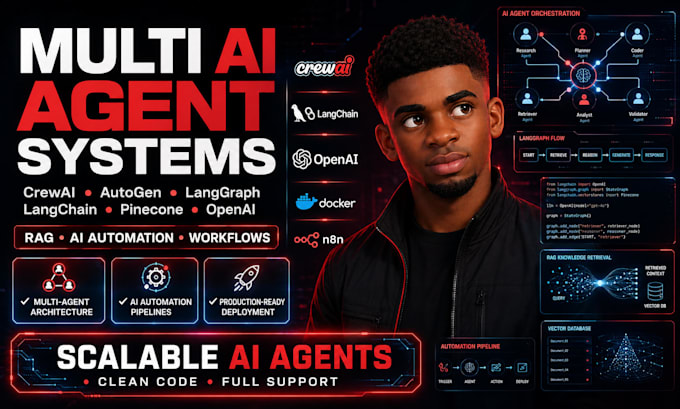
I build autonomous, scalable multi-agent AI systems using the most powerful frameworks available today.
WHAT I BUILD FOR YOU:
AI AGENT FRAMEWORKS;CrewAI Microsoft AutoGen LangGraph LangChain Semantic Kernel
️ VECTOR DATABASES & MEMORY; Pinecone Weaviate Chroma Redis PostgreSQL
LLM PROVIDERS; OpenAI (GPT-4o) Anthropic (Claude) Google DeepMind (Gemini)
️ INFRASTRUCTURE & DEPLOYMENT; Docker Kubernetes FastAPI Node.js Celery BullMQ
AUTOMATION & WORKFLOW; n8n Make.com Zapier
READY TO BUILD?
Message me NOW with your use case.
AI Automation Engineer, Multi Agent Systems, Bots And VPS Deployment
Languages
Can you build a multi-agent system where CrewAI and AutoGen agents collaborate on a single task?
Yes. I architect role-based CrewAI crews alongside AutoGen conversation agents, enabling task delegation, parallel execution and result synthesis all orchestrated through a shared LangGraph state machine with full memory persistence.
How do you handle agent memory and context persistence across long multi-step workflows?
I implement short-term memory via Redis, long-term retrieval through Pinecone or Weaviate vector stores, and structured state via PostgreSQL giving agents full contextual awareness across sessions without token bloat or hallucination drift.
Which orchestration framework do you recommend LangGraph or AutoGen and why?
LangGraph suits deterministic, graph-based workflows needing fine control over state transitions. AutoGen excels at dynamic multi-agent conversations. For complex systems I combine both LangGraph as the backbone, AutoGen handling agent-to-agent negotiation layers.
Can you integrate Semantic Kernel alongside LangChain in the same agent pipeline?
Yes. Semantic Kernel handles enterprise plugin orchestration and planner logic while LangChain manages chain composition and tool routing. Both can share the same vector store backend Pinecone, Weaviate or Chroma depending on your latency requirements.
How do you deploy multi-agent systems to production what does your Docker and Kubernetes setup look like?
Each agent service runs in an isolated Docker container. Kubernetes manages horizontal scaling, health checks and load balancing. FastAPI exposes agent endpoints, Celery or BullMQ handles async task queues, and Redis manages inter-agent messaging and caching.
Can you connect my multi-agent system to n8n, Make.com or Zapier for business workflow automation?
Absolutely. I expose agent capabilities via FastAPI webhooks that n8n, Make.com and Zapier trigger natively. This allows your agents to act on CRM events, emails, form submissions or scheduled triggers without custom integration code on your end.
Can you build agents that write and execute code autonomously, then validate their own output?
Yes. I build code-execution agents using AutoGen's code interpreter, sandboxed inside Docker containers. Agents write, run, catch errors and self-correct iteratively with human-in-the-loop checkpoints configurable at any step in the LangGraph flow.
How do you manage inter-agent communication at scale without bottlenecks?
I use Redis pub/sub for real-time agent messaging, BullMQ for priority task queuing between agents, and PostgreSQL for audit logging every agent action ensuring zero message loss and full traceability even under high-concurrency workloads.
How do you structure LangChain tool routing when agents need to decide between 10-plus tools dynamically?
I implement structured tool schemas with LangChain's ToolCallingAgent, combined with a Semantic Kernel planner for intent classification. Agents score tool relevance per subtask, preventing wrong tool selection and reducing hallucinated API calls significantly
Can you build a Kubernetes-autoscaled agent fleet that spins up new agent instances based on task queue depth?
Yes. I configure Kubernetes HPA tied to BullMQ or Celery queue metrics via KEDA automatically scaling agent pods up under load and down during idle periods, keeping infrastructure costs proportional to actual workload demand.