Browse categories
Explore
Fiverr Pro
English
$
USD



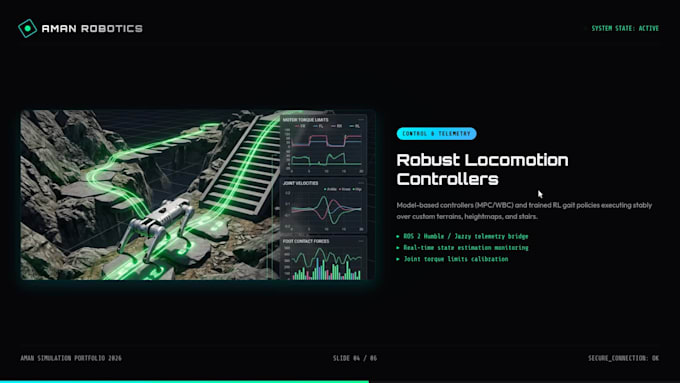
Legged locomotion is one of the hardest problems in robotics. Code that runs fine in animation breaks the moment it meets physical gravity, joint latency, and uneven terrain.
I build production-grade virtual-to-physical legged robot control systems using MuJoCo and physical SDKs (Unitree SDK2). Get a physics-accurate simulation, a trained Reinforcement Learning (RL) policy, or classical model-based controllers that transfer to your physical hardware without breaking it.
What I deliver:
- Physics-accurate MuJoCo environment (MJCF/URDF rigged and contact-tuned)
- Custom control pipelines: WBC, MPC, or Reinforcement Learning (PPO/SAC)
- Sim2Real adaptation: Latency modeling, actuator network profiling, and domain randomization
- ROS2/ROS Bridges: Stream telemetry, state estimation, and path-planning commands
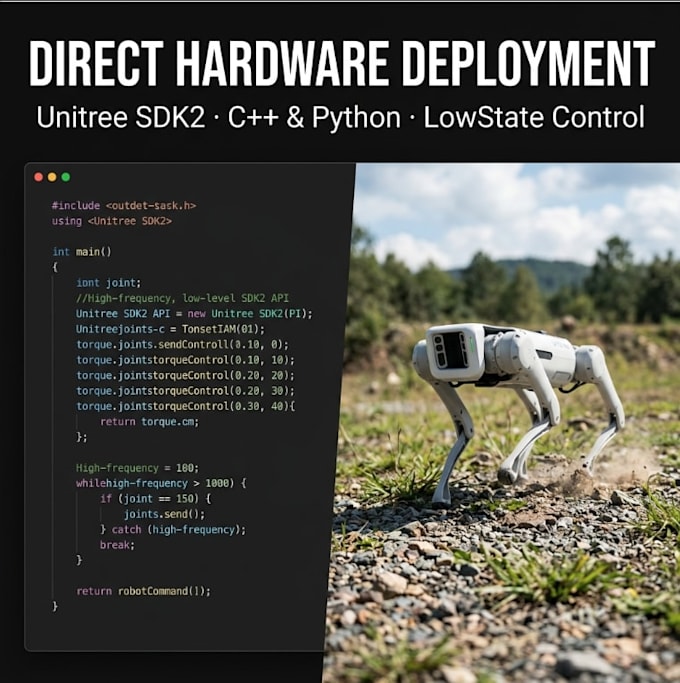
- Physical Deployment Code: C++/Python scripts utilizing Unitree SDK2 LowState streaming
Whether you are working on quadruped locomotion (Go2, B2) or humanoid control, I bridge the gap between simulation and real-world execution.
Contact me with your robot specifications and target environment to receive a custom scoping within 24 hours.
Robotics Expert
Languages
Q1. What robot platforms do you support?
I specialize in quadrupeds (Unitree Go2, Go1, Aliengo, B2, ANYmal) and bipedal humanoids (Unitree H1, G1, custom academic platforms). If your robot has a valid URDF or CAD model, it can be onboarded into my control pipelines.
Q2. What is the difference between MuJoCo and Isaac Sim for legged robots?
MuJoCo is extremely fast, computationally efficient, and handles contact physics (soft contacts, friction) with high mathematical precision, making it the academic and R&D standard. Isaac Sim is suited for large-scale GPU parallelization. I provide both, but recommend MuJoCo for rapid control protot
Q3. How do you resolve the Sim-to-Real (Sim2Real) gap?
We bridge the gap using three techniques: (1) Domain Randomization of masses, friction, and motor gains; (2) Actuator Network Modeling to simulate physical joint delays and torque ceilings; and (3) adding realistic sensor noise and latency to the policy's observation history.
Q4. Do I need to send you my physical robot?
No. I perform all builds in simulation using your CAD/URDF specs. I write the physical deployment wrapper to use your platform's standard SDK (e.g., Unitree SDK2). You run the tests locally, send me the observation logs, and we iterate remotely.
Q5. What is Unitree SDK2 "LowState Streaming" and why is it important?
LowState streaming allows us to bypass the robot's default high-level controller and read/write raw joint angles, velocities, and torques directly at high frequencies (up to 500Hz-1kHz). This is essential for executing custom locomotion behaviors, custom trot profiles, or RL policies.
Q6. What software stack do you use?
The baseline stack is Python 3.10+, MuJoCo (mujoco-python), ROS 2 (Humble/Jazzy), PyTorch (for RL pipelines), and C++ (for SDK2 low-level hardware communication). I ensure all packages match your team's local development environment.
Q7. Do you sign non-disclosure agreements (NDAs)?
Yes. I regularly sign NDAs before receiving proprietary CAD models, URDF definitions, or physical telemetry logs. Your designs and metrics will never be shared or used in my public portfolio without explicit permission.
Q8. Can you help us migrate our Gazebo or Webots controllers?
Yes. I can translate your existing controllers (e.g. ROS controllers or custom PyBullet nodes) into MuJoCo, optimizing for MuJoCo's faster contact solver and setting up more reliable contact tracking.
Q9. Who owns the code and trained neural networks?
Upon project completion and milestone release, you own 100% of the code, scripts, configurations, and trained model weights (ONNX/TorchScript) with full commercial rights.
Q10. How do milestones work for these high-ticket projects?
For Standard and Premium packages, we break the project into 3 to 5 milestones (e.g., Env Build, Policy Training, SDK Integration, Hardware Validation). Each milestone concludes with a video demo and code delivery. You only fund the next milestone once you approve the current one.