Browse categories
Explore
Fiverr Pro
English
$
USD
Is your database running slow, causing high CPU usage, timeouts, or blocking your users?
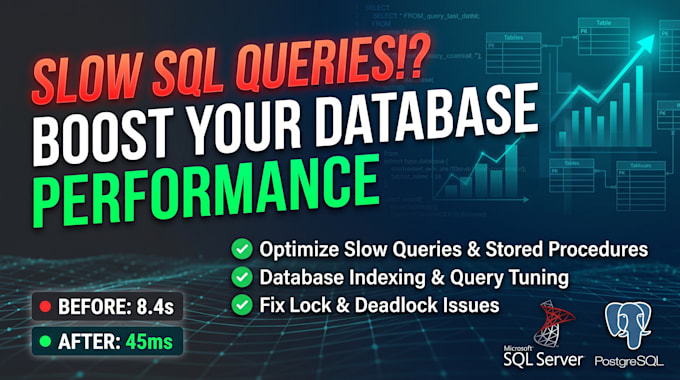
A single unindexed table scan or inefficient JOIN can freeze your entire application. As a backend and database specialist with deep experience in MS SQL Server and PostgreSQL, I locate bottlenecks and accelerate queries from seconds to milliseconds.
What I deliver:
Execution Plan Analysis: Pinpointing costly table scans, index scans, and parameter sniffing.
Query Refactoring: Rewriting slow JOINs, subqueries, and complex CTEs into clean, fast SQL code.
Index Optimization: Creating missing clustered/non-clustered indexes and removing redundant ones.
Stored Procedures Tuning: Fixing slow SP execution, table variables, and dynamic SQL bottlenecks.
Lock & Deadlock Troubleshooting: Solving concurrency issues and blocking chains.
Supported Engines:
Microsoft SQL Server (All versions, Azure SQL)
PostgreSQL (Cloud RDS, Supabase, On-Prem)
SQLite & MySQL
Please message me before placing an order with your query or schema details so we can choose the best scope!

Platform:
MS SQL
•
MySQL
•
PostgreSQL
•
SQLite
Expertise:
Normalization
•
SQL
•
Performance
•
Query optimization
How do we handle database access and sensitive data security ?
Data confidentiality is strictly guaranteed. You do not need to share sensitive production data. In most cases, I only need the query text, table schema (CREATE TABLE scripts without actual data), and the Execution Plan. If direct access is necessary, we can work via AnyDesk, TeamViewer, or use anon
Can you optimize complex Stored Procedures or dynamic SQL ?
Yes. I handle complex stored procedures, multi-statement table-valued functions, and dynamic SQL queries. I refactor them to eliminate costly scans, remove inefficient temporary tables, and resolve parameter sniffing issues.
How much performance improvement can I expect ?
While results depend on server hardware and architecture, targeted query optimization and proper indexing typically yield an 80% to 95% reduction in execution time and I/O overhead (e.g., dropping queries from 10+ seconds down to under 200ms).
Will adding new indexes slow down my INSERT and UPDATE operations?
Over-indexing can negatively impact write performance. My approach relies on targeted, high-impact indexes and dropping redundant or unused indexes, ensuring write speeds remain balanced and fast.
