Browse categories
Explore
Fiverr Pro
English
$
USD

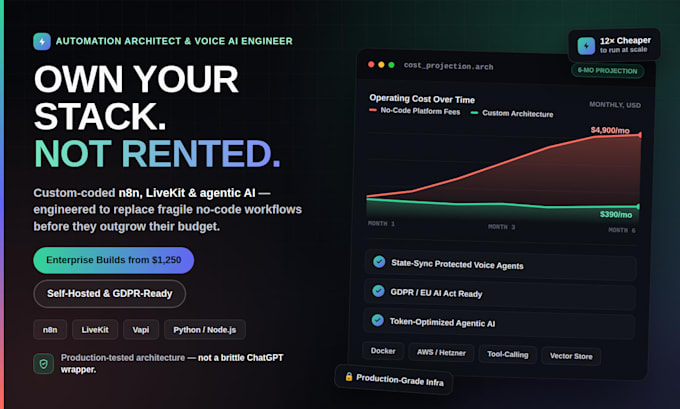
Building AI voice agents, voice cloning, AI dubbing, or agentic automation but keep running into API limits, high per-character costs, complex tool-calling,unreliable workflows?
I'M here for you, you need a robust self hosted system to solve this .
Full-Stack Custom Dashboard Platforms
Self-Hosted Voice AI Cloning
Dubbing And Translation Pipelines
Custom Middleware & AI Infrastructure
LiveKit Vapi ElevenLabs Voice Agents
Message me
FULL STACK AI VOICE PRODUCTION ENGINEER
Languages
Can you build a voice cloning platform with no third-party character limits?
Yes. A self-hosted architecture can reduce dependence on third-party per-character or usage-based limits. Your actual capacity will depend on the selected model, GPU resources, concurrency, audio quality, and infrastructure configuration.
Can you build an AI dubbing system for videos?
Yes. I can build an automated AI dubbing pipeline that processes audio/video, transcribes speech, detects speakers, translates the content, generates cloned voices, synchronizes the audio, and produces the final dubbed media.
What technology do you use for AI dubbing?
Depending on the project, I can combine Whisper for speech-to-text, speaker diarization, translation models/APIs, F5-TTS, XTTS-v2, CosyVoice or ElevenLabs for voice synthesis, and FFmpeg for audio/video processing and alignment.
Can you build both the frontend and AI backend?
Yes. I can handle the complete full-stack implementation, including a Next.js/React dashboard, Python FastAPI backend, AI processing engine, database, authentication, file storage, GPU workers, APIs, and deployment infrastructure.
Do you write custom code inside n8n, Make, or Zapier?
Absolutely. While I use these platforms for visual orchestration, I write custom JavaScript/Python inside Code Nodes—or build standalone PHP/Python microservices—to handle heavy data parsing, pagination, and multi-tier API authentication efficiently.
Can you help me migrate from Zapier/Make to a self-hosted n8n instance?
Yes. I specialize in deploying self-hosted n8n using Docker on your cloud infrastructure (AWS, DigitalOcean, Hetzner). I will migrate your workflows, configure task runners, and set up security protocols to ensure your data processing aligns with regional privacy guidelines.
How do you prevent LiveKit agents from breaking when a user interrupts them?
I write specialized Python or Node.js state-management middleware. If a user interrupts the bot mid-sentence, the middleware intercepts the event, safely pauses or rolls back the active background tool-call, and updates the agent's context window instantly to prevent database corruption.
Can you build multilingual AI voice and dubbing systems?
Yes. I can build multilingual pipelines that combine speech recognition, translation, speaker handling, voice cloning/TTS, and audio alignment. Supported languages and voice quality depend on the models and services selected for your project.
Can you build a proof of concept before developing the complete platform?
Yes. For complex voice cloning or dubbing platforms, I recommend starting with a focused proof of concept. This allows us to validate voice quality, language support, speaker handling, processing speed, synchronization, and GPU requirements before investing in the complete production system