Browse categories
Explore
Fiverr Pro
English
$
USD
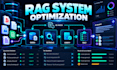
Build an AI knowledge base that answers from your documents with source references.
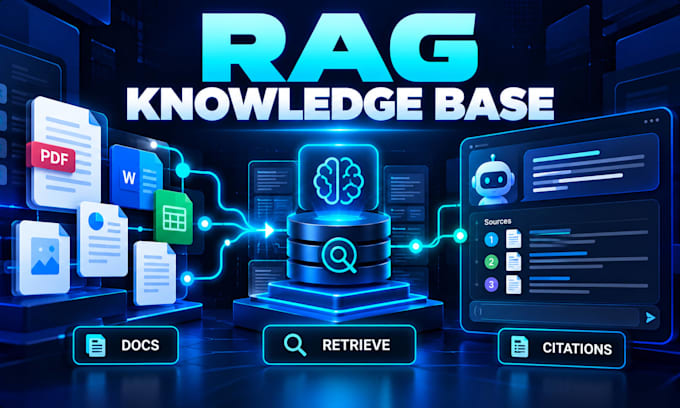
I create RAG systems for document Q&A and internal knowledge search. PDFs, DOCX, FAQs, SOPs, manuals, webpages, or selected databases are processed and indexed so answers point to relevant sources.
WHAT I CAN BUILD
I use Python, LLM APIs, and suitable RAG frameworks; the stack depends on your data and app.
Document/source limits apply. Large migrations, knowledge graphs, custom SaaS interfaces, and complex multi-tenant permissions need a custom scope.
Send document types, volume, sample questions, current stack, user roles, and target outcome before ordering.
AI Systems Specialist, Automation, Generative AI and Content Workflow for Smart
Languages
Can you build a knowledge base from my PDFs and business documents?
Yes. I can build a RAG knowledge base using supported PDFs, DOCX files, FAQs, SOPs, manuals, webpages, or other agreed sources. Scanned files, complex tables, and unusual formats may require additional processing.
Will answers include source citations?
Source-grounded answers and citations are included in the agreed scope. The available citation detail depends on the source parser and whether the original files expose reliable page or section metadata.
Can the system avoid making up answers?
I can configure retrieval-grounded responses and a fallback when the retrieved evidence does not support an answer. No AI system can be guaranteed to produce zero errors, so representative testing and clear limitations are important.
Can you fix an existing RAG chatbot that retrieves the wrong information?
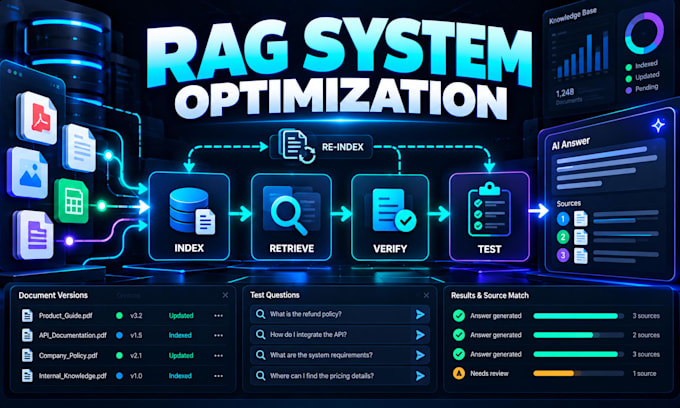
Yes. I can investigate extraction, chunking, embeddings, search, filtering, ranking, and answer-generation behavior. The appropriate package depends on whether the work is a contained fix or a broader rebuild.
Can documents be updated without rebuilding the entire knowledge base?
Yes, where the chosen architecture supports it. I can configure document updates and re-indexing so new versions can replace outdated content rather than leaving stale information in retrieval results.
Can you use Supabase and pgvector?
Yes, where appropriate for the project. Supabase supports vector search with pgvector and also documents semantic, keyword, and hybrid search approaches.
Can you restrict access to different documents?
Access filtering can be implemented when supported by the application's authentication and data architecture. It must be enforced at the appropriate backend or retrieval layer rather than relying only on prompt instructions.
Can you migrate an existing knowledge base or Q&A system?
Yes. I can review the current sources, retrieval design, database, and dependencies before proposing the migration. Larger migrations need a custom scope after the existing system has been assessed.
Does this Gig include a complete multi-tenant SaaS application?
No. This Gig focuses on the knowledge and retrieval system. A full SaaS product with user management, tenant isolation, billing, dashboards, and application development belongs in the separate AI SaaS Gig.
What do you need before starting?
Please provide your goal, document types and approximate volume, sample questions, current stack, required integrations, user roles, and deployment preferences. Do not send passwords or secret API keys through plain chat.