Browse categories
Explore
Fiverr Pro
English
$
USD
pcb design
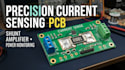
I will design a precision current measurement PCB using a shunt resistor and current-sense amplifier for power monitoring, battery systems, motor controllers, and embedded electronics.
What I can design:
What you will receive:
I focus on practical component selection, careful shunt routing, noise reduction, and measurement-circuit design tailored to your current range and accuracy requirements.
Please message me before placing an order so we can confirm your requirements and project scope.

What is a shunt amplifier current measurement PCB?
It measures the small voltage across a shunt resistor and amplifies that signal so a controller or ADC can measure current.
Can you design high-side and low-side current sensing circuits?
Yes. The suitable approach depends on the supply voltage, common-mode voltage, current range, and measurement requirements.
Can you design a precision current measurement circuit?
Yes. I can account for amplifier offset, shunt tolerance, temperature effects, gain, noise, and ADC resolution during design. Actual accuracy requires validation.
Can the PCB connect to ESP32 or STM32?
Yes. The analog output can be designed to suit the selected controller's ADC input range and electrical requirements.
Can you include Kelvin connections?
Yes. Separate sense connections can reduce errors caused by voltage drops in the high-current paths when implemented correctly.
Can you design for battery or motor current monitoring?
Yes. Share the expected current, voltage, transient conditions, and operating environment so the shunt, amplifier, and PCB layout can be selected appropriately.
Do you provide calibration and physical testing?
Not by default. Calibration, prototype fabrication, and measurement verification require a separate agreement.
