Browse categories
Explore
Fiverr Pro
English
$
USD
pcb designer and firmware developer
Hello and Welcome!
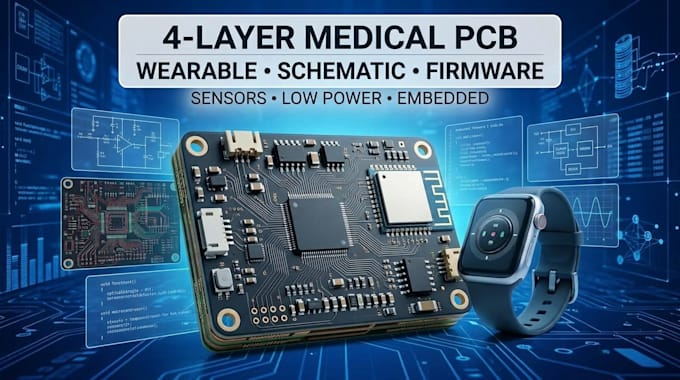
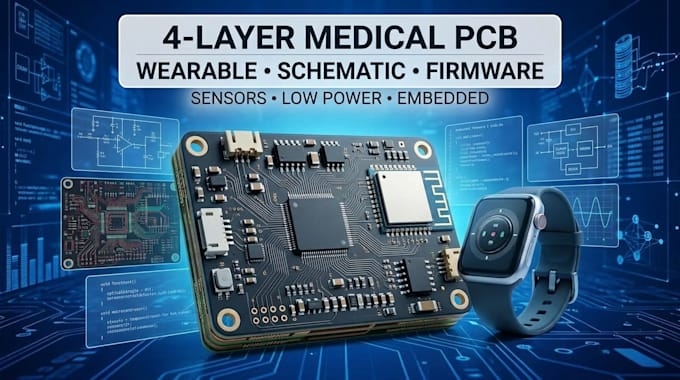
Medical and wearable electronics require more than a compact PCB. Sensitive sensor signals, low-power operation, grounding, EMI control, thermal behavior, component placement, and embedded firmware must work together to produce a stable and manufacturable system.
I will design 4-layer medical and wearable PCBs with complete schematics, embedded firmware integration, sensor interfaces, and manufacturing-ready documentation based on your technical and mechanical requirements.
What I Will Provide:
Why Choose Me:
Lets build your wearable medical PCB, send your requirements and start your project today!!
Can you design a complete 4-layer medical PCB?
Yes. I can handle the schematic, component selection, PCB layout, DRC, BOM, and manufacturing files.
Do you design wearable PCBs?
Yes. I can design compact wearable boards with sensors, MCU, battery management, wireless connectivity, and required interfaces.
Can you develop the embedded firmware too?
Yes. I can develop firmware for sensor acquisition, MCU peripherals, communication, power management, and device control.
Can you integrate medical or biometric sensors?
Yes. I can integrate supported sensors for applications such as temperature, motion, optical, pressure, and other measurements based on your specifications.
Can you design low-power wearable electronics?
Yes. I can optimize power architecture, battery management, sleep modes, peripheral usage, and power distribution.