Browse categories
Explore
Fiverr Pro
English
$
USD
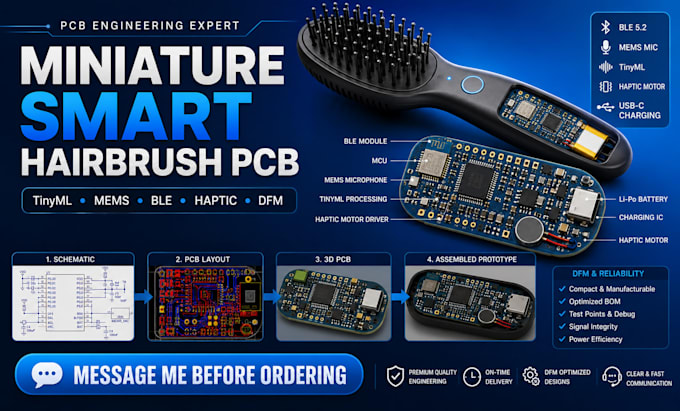
Your Hairbrush Shouldnt Fight Your Electronics.
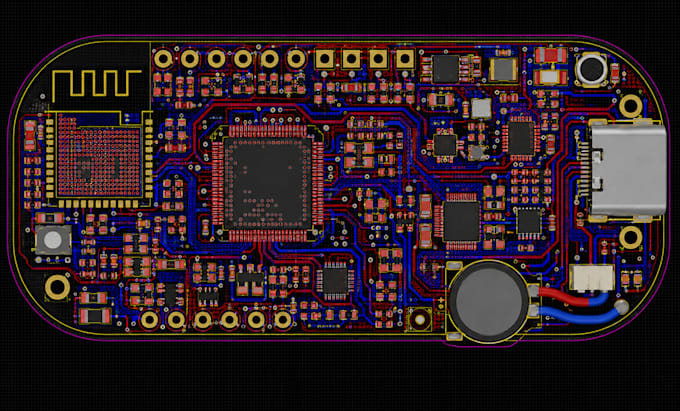
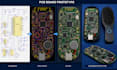
Tiny space, noisy sensor signals, battery limitations, BLE instability, vibration interference, ESD risks, and manufacturing failures can turn a promising smart hairbrush into an expensive prototype problem. I engineer the electronics around those real constraints.
WHAT I'LL ENGINEER:
WHY MY APPROACH WORKS?
WHAT LANDS IN YOUR HANDS:
Stop guessing why your smart hairbrush prototype fails. MESSAGE ME BEFORE ORDERING and let's engineer the electronics around your product.
Can you prevent TinyML, MEMS microphone, BLE, and haptic circuits from interfering with each other?
Yes. I separate sensitive signals, manage grounding, power integrity, RF placement, and noise paths so the features can coexist reliably.
Will the PCB actually fit inside my tiny hairbrush housing?
Yes. I account for board thickness, component height, battery clearance, button placement, and enclosure tolerances before finalizing the layout.
How do you protect the MEMS microphone from motor and haptic noise?
I treat acoustic and mechanical noise as an engineering problem, using placement, isolation, filtering, grounding, and signal routing strategies appropriate to the design.
What happens if the PCB works electrically but fails inside the finished product?
I design around the real product environment enclosure geometry, battery, charging, haptics, BLE antenna space, heat, assembly, and user interaction. So the PCB is built for the product, not merely the schematic.
What if my first prototype works but cannot be manufactured consistently?
I apply DFM thinking from the beginning, considering assembly access, component availability, tolerances, footprints, and production constraints not just prototype functionality.