Browse categories
Explore
Fiverr Pro
English
$
USD




Are you struggling to find profitable keywords that actually convert on Amazon?
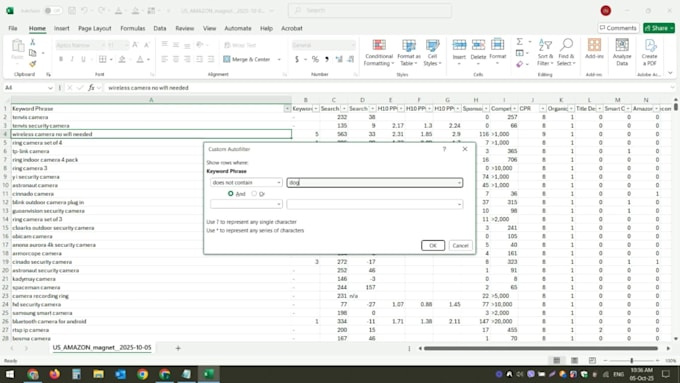
Ill help you discover high-converting, low-competition list using Helium 10 tools (Magnet & Cerebro) the same tools top Amazon sellers and agencies use to dominate search results.
What You'll Get:
Why Choose Me:
You'll receive a complete Kw research report including:
Since 2016 I helped more than 100 brands scale on Amazon
Languages
What is the best practice when running a keyword research for Amazon SEO and Amazon PPC?
The best practice is to use Helium10 extracts from Magnet and Cerebro, and then comb through them manually. Then you will minimize mistakes that would come from misunderstanding the fit between product and the market. Also, double checking everything before delivering is necessary.
What is the difference between search terms and keywords on Amazon?
Keywords are single or multiple words combined, in an effort to boost discoverability of your Amazon product on Amazon website. We use keywords as our closest guess what customers type in when they search for your products. Search terms are words that customers actually type in the search bar.
What is the best keyword research tool on Amazon?
Right now the golden industry standard is Helium10 and our team is using it. Other honorable mentions are: Jungle Scout, AMZ Scout, Data Dive, ZonGuru and Smart Scout
What is Amazon keyword research and why is it important?
Amazon keyword research means discovering the exact words and phrases customers use when shopping on Amazon. By optimizing your product titles, bullet points, and backend search terms with these keywords, you increase your chances of appearing in relevant searches.
What are short-tail vs. long-tail (and branded vs. non-branded) keywords on Amazon, and how should I use them?
Short-tail keywords are broad one- or two-word terms (e.g. “laptop”) that get high search volume but face stiff competition. Long-tail keywords are longer, more specific phrases (usually 3+ words, e.g. “lightweight laptop for college”) with lower search volume but less competition.
How do i find relevant keywords for my Amazon product listing?
I begin with Amazon’s own tools: use the search bar auto-complete (type a relevant word and note the suggested terms). Also, Amazon Brand Analytics dashboards can reveal the top search terms shoppers use for your product category. In addition, third-party tools like Helium 10’s Magnet and Cerebro.
How do I use Helium 10’s Cerebro to uncover competitor keywords?
Cerebro is Helium 10’s reverse-ASIN search tool. We copy a competitor product’s ASIN (in your target marketplace) and paste it into Cerebro; it will show all the keywords that product ranks for. Cerebro discovers which high-performing keywords your competitors are using, so you can add those.
Are Amazon keyword research tools (like Helium 10, Jungle Scout, etc.) accurate and reliable?
Yes – most reputable tools provide reasonably accurate estimates of search volume and competition. However, be aware that different tools use different data sources and formulas, so their numbers can vary.
How do I choose keywords to bid on for Amazon PPC campaigns?
First, perform thorough keyword research (with Magnet, Cerebro, Amazon auto-suggest, etc.) to compile all relevant terms. When you create a PPC campaign, Amazon will suggest bid prices for each keyword. Beginners often start by targeting their top 5–10 most relevant and high-potential keywords.
How do keywords and search trends differ across Amazon marketplaces, and how should I research accordingly?
Keyword popularity and competition often vary greatly between marketplaces (US vs UK vs DE vs CA, etc.). Helium 10 warns that you must research marketplace-specific keywords: a term that is niche in one country might be huge in another.