Browse categories
Explore
Fiverr Pro
English
$
USD




Do you have a board game that works but you are not sure whether it is truly balanced?
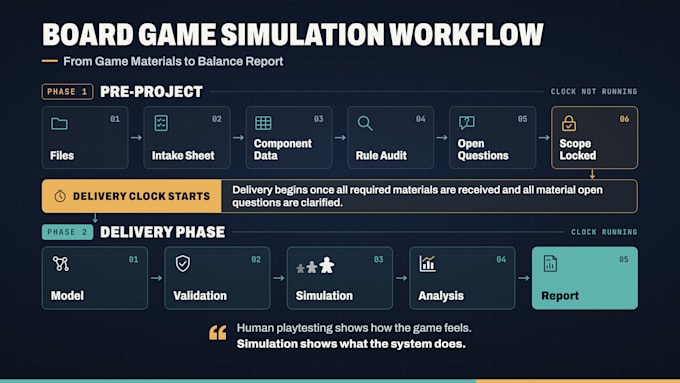
Human playtesting shows how a game feels. Simulation shows what the system actually does.
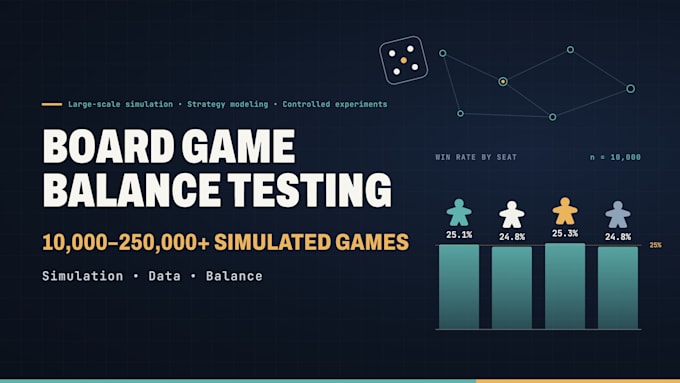
I convert your board game's rules into a mathematical simulation model, validate it against the intended rules, and run large-scale simulations to identify balance issues, statistical bias and unexpected system behaviour.
Analysis may include win rates, player-count balance, turn-order advantage, game length, strategy performance, economy, card/faction balance, dominant strategies and controlled rule variants.
PRE-PROJECT: Files Intake Sheet-Component Data-Rule Audit-Open Questions-Scope Locked
DELIVERY: Model Validation-Simulation-Analysis Report
Input quality matters: better input produces better simulation results. Your game materials and results are treated as confidential and are not intentionally shared or published without your permission.
Delivery time begins once all required materials are received and material open questions are clarified.
Simulation complements human playtesting; it does not replace it.
For complex games, please contact me before ordering Standard or Premium.
I will mathematically simulate and balance test your board game
Languages
Does simulation replace human playtesting?
No. Human playtesting is essential for evaluating fun, clarity, interaction and player experience. Simulation focuses on probabilities, balance and system behaviour. The two methods complement each other.
Can every board game be simulated?
No. Games with structured rules, measurable states and defined decisions are the best candidates. Highly social, negotiation-heavy or storytelling-driven games may require assumptions or may not be suitable for meaningful large-scale simulation.
How many games will you simulate?
Depending on the selected package, I run a minimum of approximately 10,000 to 250,000+ simulated games. Simulation counts are minimum project totals. Additional runs may be performed when required to achieve stable results, at no additional charge.
Do I receive the simulator or source code?
No. The standard deliverable includes the analysis, report and package-specific data. Simulator or source-code handover can be quoted separately as a custom project.
What happens if my rules or component data are incomplete?
I will identify important missing or unclear information and ask for clarification before those mechanics are used in the simulation. I will not silently invent rules or values that could materially affect the results.
Is my game information confidential?
Yes. Your rulebook, component data, files, simulation inputs and project results are treated as confidential project information and are not intentionally shared, published or used in public portfolio materials without your permission. If needed I have a signable DNA.
When does the delivery time start?
The delivery period begins once all required materials have been received, the simulation scope has been agreed, and all material open questions identified during the rule audit have been clarified.
Can you test different versions of a rule?
Yes. Standard and Premium packages include controlled experiments where selected rule or balance variants can be compared against the baseline version of the game.
What does “player count” mean?
“Player count” means the number of players participating in the game, tested as a separate configuration. For example, if your game supports 2–4 players, the following are three different player counts: 2-player games 3-player games 4-player games Each player count may behave differently!
Do you use AI tools during the project?
Yes. I may use professional AI-assisted development tools such as Claude Code to help build and test the simulation model efficiently. However, rule interpretation, project scope, validation decisions, experiment design and final analytical conclusions are reviewed manually.