Browse categories
Explore
Fiverr Pro
English
$
USD


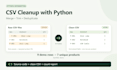
Get a repeatable Python workflow for product CSV cleanup.
I provide a local script that merges UTF-8, comma-separated CSVs with matching columns, trims surrounding whitespace, and removes duplicate SKUs. Matching is exact and case-sensitive after trimming. Each SKU keeps its first entire row in the agreed input order, even if other cells are blank.
You receive source code, a clean CSV, a JSON count report, and instructions. Original files and existing output files are protected. Missing columns, mismatched headers, empty SKUs, and malformed rows stop the run with an error.
Each checked run covers up to two CSVs, 20,000 product records, and 10 MB total input. Packages differ in included checked runs and documentation. The delivered script can be reused; it uses local Python and needs no paid API.
My synthetic validation checked 20,000 records and 10 MB of data, including Chinese text, commas, and quotes. I use AI-assisted development and verify agreed results.
Contact me with anonymized samples, expected output, and your Python/OS environment before ordering. Different sizes or structures need scope confirmation.
Python CSV Automation Developer
Languages
What files are supported?
UTF-8 comma-separated CSVs, with or without a BOM. Each needs SKU and the same columns in the same order. Per run: up to 2 CSVs, 20,000 product records excluding headers, and 10 MB combined input (10,000,000 bytes). Send anonymized samples and your environment before ordering.
Which duplicate is retained?
After trimming, each exact, case-sensitive SKU retains its first entire row, including blank non-SKU cells. The agreed file/row order determines priority; later duplicates are removed. A and a remain different SKUs.
What happens to invalid rows?
Missing columns, incompatible headers, empty SKUs, malformed quoted rows or incorrect field counts stop the run with an error. Empty CSV records are skipped and counted. We confirm these fixed rules match your needs before the order.
What do I need to run it?
Python and a filesystem supporting hard links, such as NTFS. Tested on Windows with Python 3.13.8. Use a writable existing output folder and new filenames. Confirm your specific environment before ordering.
Will it change my original files?
The workflow reads source files and writes to separate new paths. It rejects output paths that equal an input and refuses to overwrite existing destination files.
How is the work checked?
Ten tests include a legal quoted field in a 10 MB input and invalid long-field rejection. Independent 20,000-record/10 MB validation checked counts, all expected SKUs, first-row values and unchanged input hashes. Client speed depends on the data and environment.
What does a revision cover?
A revision corrects results or instructions within the agreed merge and trim rules, keeping the first row for each SKU, and count reporting. Different transformations, formats or integrations need a separate feasibility check.
What if my files differ?
Send anonymized samples, total records/bytes and your Python/OS details before ordering. We confirm the fixed workflow fits. Different sizes, columns, encodings, delimiters or cleanup rules require a scope/feasibility check first.
Can I reuse the script?
Yes. The 1/2/3 checked runs are the agreed input sets I validate and deliver with your order. They do not limit how many times you can run the provided source code on data that fits the agreed workflow and your environment.
