Browse categories
Explore
Fiverr Pro
English
$
USD
PostgreSQL Data Recovery Specialist , PostgreSQL ACE
I provide read-only PostgreSQL data recovery for authorized systems. This Gig focuses on databases that will not start, while also covering four connected recovery scenarios:
Dropped objects: DROP DATABASE, DROP SCHEMA or DROP TABLE Startup failure: FATAL/PANIC, invalid checkpoint, control-file or WAL problems Mistaken data loss: DELETE, UPDATE or TRUNCATE Corrupted data files: damaged PGDATA, relation files, pages, TOAST, checksums or disk I/O errors
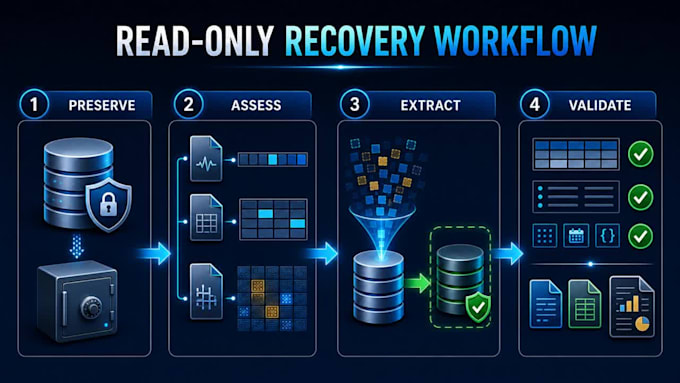
I preserve the source and reproduce the problem on a copy. Depending on the incident, I analyze startup logs, control data, WAL timelines, catalogs, relation files, page structure, tuple remnants, TOAST and known DDL.
The safest result may be extracting usable data into a clean PostgreSQL cluster rather than forcing the damaged source to start. Deliverables may include SQL, COPY or CSV, recovered object definitions, validation results and a report.
Recovery is best-effort. Do not run pg_resetwal or initialize a replacement cluster on the only copy before assessment.
Only systems and data you own or are authorized to administer.




Database type:
Relational database
Can you make every failed cluster start again?
No. In some incidents the safest outcome is extracting usable data into a clean cluster rather than forcing the damaged source to start. I will explain the evidence and realistic options.
Should I run pg_resetwal first?
No. Preserve a full copy before any destructive repair attempt. pg_resetwal may make a cluster start but can remove evidence or create inconsistencies that complicate recovery.
Which startup errors can you investigate?
FATAL or PANIC startup failures, invalid checkpoint or WAL errors, control-file problems, broken catalog state, missing or damaged relation files, and storage I/O faults.