Browse categories
Explore
Fiverr Pro
English
$
USD


Your app works. Sort of. But every new feature breaks something else, nobody can read the code, and you're not sure what half of it does.
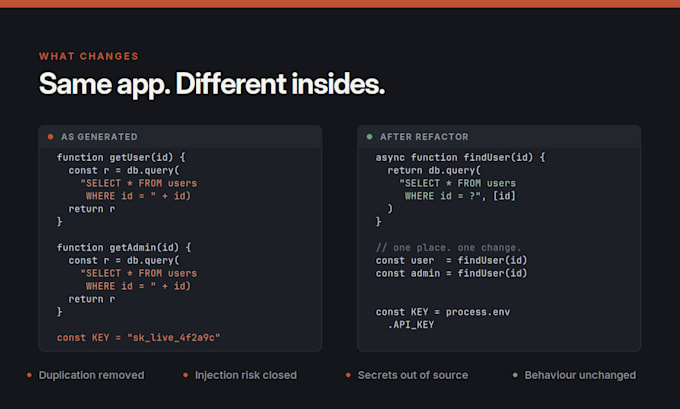
That's what happens when an AI writes a codebase one prompt at a time. Each piece is fine in isolation. Together they're a mess: duplicated logic in six places, no structure, secrets sitting in the source, no error handling, dependencies you don't need. I untangle it.
What I do
What stays the same
Behaviour. Your app does exactly what it did before, unless we agreed otherwise. Refactoring means changing the inside, not the outside.
I'm a security engineer by trade with a software engineering background. I read other people's code for a living.
Security and Software Engineering
Languages
Will my app still work the same after?
Yes. That's the whole point of refactoring — the inside changes, the behaviour doesn't. I check the current behaviour before I start and verify against it after. If I think something needs to change, I ask first.
I built this with Cursor / Lovable / v0 / Claude. Can you work with it?
Yes, all of them. The tool doesn't really matter — the problems are the same ones every time: duplicated logic, no structure, no error handling, and secrets left in the source.
How do I know how many lines my project is?
Run "git ls-files | xargs wc -l" in your project folder and send me the last number. Or just send the repo and I'll check. Don't count node_modules or anything you didn't write.
Can you add features while you're refactoring?
I keep those separate. Mixing new features into a refactor is how things quietly break. Happy to quote the feature work as its own order once the cleanup is done.
What if my code is too far gone to fix?
Sometimes it's cheaper to rebuild than repair. I'll tell you that before you order rather than after, and quote the rebuild instead. I'd rather lose the sale than deliver something disappointing.
Do I need to give you access to my live site or database?
No. I only need the source code. Never send me passwords, API keys, or production credentials — if there are keys in your repo, flagging those is part of the job.
Will you write tests?
You can add tests as an extra. Not exhaustive coverage — enough that you'll know when something breaks.
What do I actually receive?
The refactored code as a pull request or zip, whichever you prefer, plus a written summary of what changed and why.