 September 30, 2026
 14 minute reading
Most manuscripts do not get edited once. They get edited in layers, and the four editorial stages that make up that sequence each solve a different problem. Developmental editing fixes structure, line editing shapes the prose, copyediting enforces correctness and consistency, and proofreading catches remaining errors. Hiring the wrong editor first is the most common and most expensive mistake in the process, because a beautifully copyedited chapter that later gets cut has to be paid for twice.
Whether you are self-publishing a debut novel, running a corporate publishing program, or shipping a long-form content asset, you can find book editing and proofreading professionals on Fiverr for each stage individually or for the full sequence.
This guide covers what each editing stage delivers, how to work out realistic turnaround times, how editorial pricing is structured, and how to run a sample edit before you sign anything.
Marketplace figures in this guide are based on completed Fiverr projects over the trailing 12 months (September 2025 to August 2026).
At a glance: the four editorial stages

- The four editorial stages run in a fixed order: developmental, line editing, copyediting, then proofreading. Each stage assumes the one before it is finished.
- Developmental editing works at the level of structure and argument. Proofreading works at the level of the typo. The stages in between narrow steadily in scope.
- Proofreading is the most commissioned stage on Fiverr at 50.3% of stage-tagged editorial projects, followed by copyediting at 27.6%. Developmental editing is the least commissioned relative to how much it changes a book.
- Turnaround depends on manuscript length, text complexity, and the editor's queue, not just their working pace. Ask for all three when you request a quote.
- Editorial pricing is quoted per word, per standard page, per hour, or as a flat project fee. The same project can be priced all four ways and land in a similar place.
- A sample edit of 1,000 to 2,000 words is the single most reliable way to compare candidates, and Fiverr lets you run that test with several professionals before committing to a full manuscript engagement.
What are the editorial stages, and why do they run in this order?
The editorial stages are four sequential passes over a manuscript, each one narrower in scope than the last. They run in order because every stage assumes the text below it is stable. There is no point polishing sentence rhythm in a chapter that developmental editing is about to delete, and there is no point proofreading a page that has not been through layout yet.
That sequence is also why the industry treats these as separate services rather than one bundled edit. A developmental editor is doing structural and analytical work. A proofreader is doing forensic comparison work. Those are different skills, and many professionals specialize in one or two of the four rather than all of them.
For corporate publishing teams and content marketing managers, the same logic applies with different vocabulary. The developmental pass is the one where you decide whether the argument holds and whether the chapters are in the right order. The copyediting pass is where house style, terminology, and legal or compliance language get enforced. Skipping straight to a proofread on a document that has never had a structural review is how a well-formatted, error-free, unconvincing report gets published.
Stage 1: Developmental editing
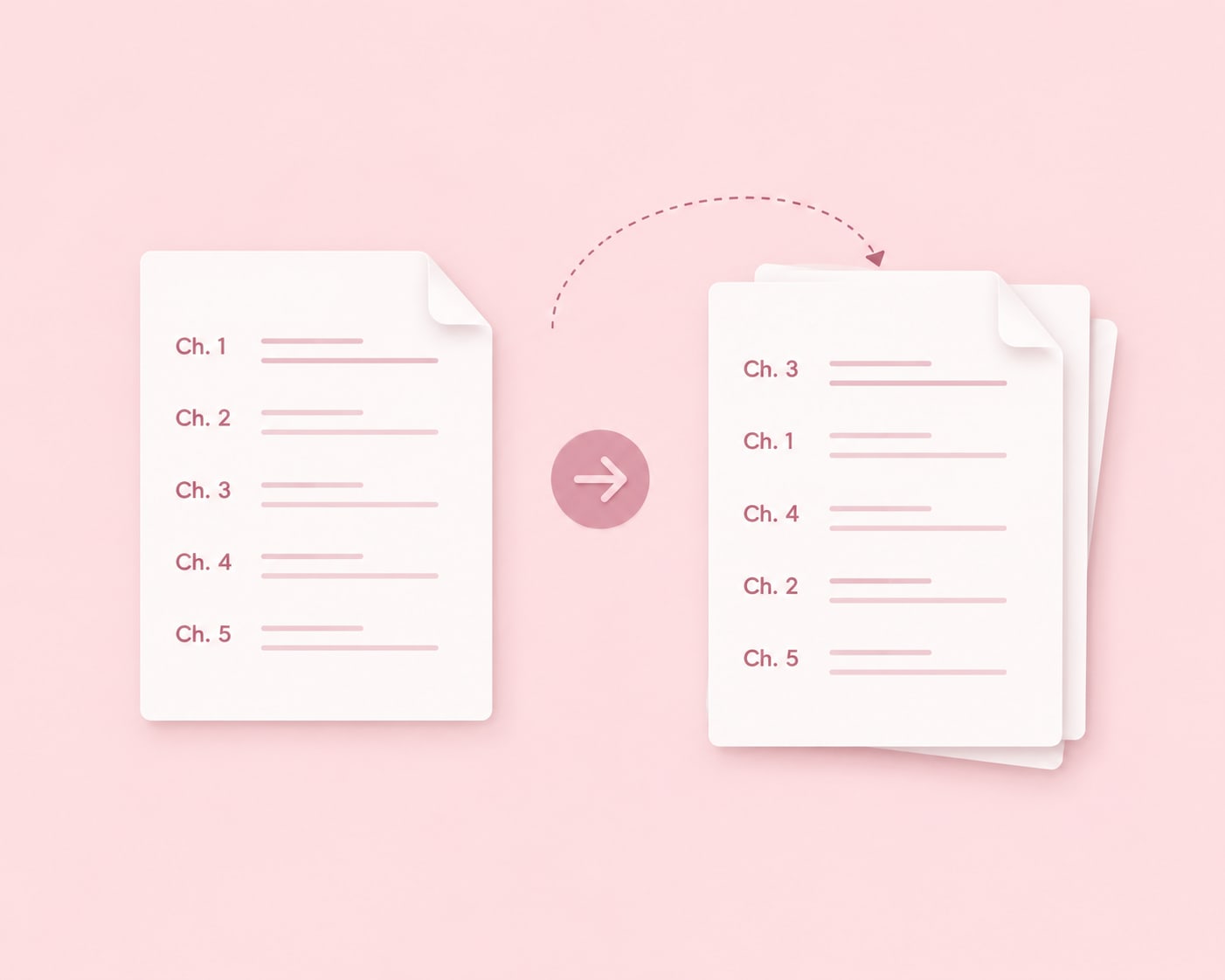
Developmental editing assesses and reshapes the big picture, including structure, argument, pacing, character, and whether the manuscript delivers what it promises. It is the most intensive of the editorial stages and the one that changes a book most.
A developmental editor reads the manuscript as a whole before commenting on any part of it. The work is diagnostic first and prescriptive second, which is why it is usually delivered as commentary rather than as direct rewriting of your text.
What you should receive
- An editorial letter, typically several pages long, assessing structure, argument or plot, pacing, and audience fit.
- In-manuscript comments flagging specific passages that illustrate the letter's points.
- Chapter-level or section-level notes, often including a suggested reordering.
- A follow-up call or written round of questions, where the editor offers this.
When your manuscript is ready for it
Your draft should be complete, self-edited at least once, and structurally settled enough that you are not still adding chapters. Developmental editing on a half-finished manuscript produces advice you cannot act on. If you want reader-level reaction before a professional assessment, a beta reading pass is the lower-cost first step.
Expect to do substantial revision work after this stage. That revision time is part of your schedule, and authors routinely forget to budget for it.
Stage 2: Line editing

Line editing works sentence by sentence on clarity, rhythm, voice, and word choice. It sits between developmental editing and copyediting, and it is the stage most often confused with the one on either side of it.
The distinction that matters in practice: a line editor is asking how a sentence lands, not whether it is correct. Two grammatically flawless sentences can be swapped for a third that says the same thing with more force, and that is line editing. Some professionals call this substantive editing or heavy copyediting, so confirm the scope rather than relying on the label.
What you should receive
- Tracked sentence-level revisions throughout the manuscript.
- Queries where the editor needs your decision rather than making the call themselves.
- Notes on recurring habits, such as filler constructions, repeated sentence shapes, or tonal drift between chapters.
Line editing is where voice preservation matters most, and it is the stage where a sample edit is most revealing. Two editors given the same page will produce visibly different results, and only one of them will sound like you.
Stage 3: Copyediting

Copyediting enforces correctness and consistency, including grammar, punctuation, usage, spelling, continuity, and adherence to a chosen style guide. It is mechanical work in the best sense, and it is the stage that produces the reference document your later stages depend on.
The deliverable people overlook here is the style sheet. A copyeditor should build a record of every decision made: hyphenation choices, capitalization, number treatment, character or product name spellings, timeline details, and any deviation from the base style guide. That sheet is what a proofreader checks against later, and for a corporate publishing program it becomes reusable house style documentation.
What you should receive
- The manuscript with tracked changes, plus queries for anything requiring your judgment.
- A completed style sheet.
- Confirmation of which style guide governs the project, whether that is Chicago, AP, an internal house style, or a hybrid.
What to confirm before you book
- Whether the quote covers one pass or includes a review of your responses to queries.
- Whether fact-checking is included. It usually is not, and for nonfiction it is often a separate engagement.
- Whether the editor works to your existing house style sheet or builds one from scratch.
Stage 4: Proofreading

Proofreading is the final quality check before publication, carried out after the text has been formatted or typeset. A proofreader catches surviving typos, spacing and layout problems, bad line breaks, inconsistent running heads, page numbering errors, and anything that slipped through copyediting.
The key distinction from copyediting is timing and object. Copyediting happens on the manuscript. Proofreading happens on the version readers will actually see, which means the proofreader is checking the document as an artifact, not just as text. This is why a proofread commissioned before formatting misses an entire class of error.
Proofreaders do not restructure, rewrite, or make stylistic suggestions. If a proofreader is returning substantive rewrites, the manuscript was not ready for this stage.
What you should receive
- Either a marked-up PDF with comments for your designer, or a tracked-changes file if you are working in a word processor.
- A short summary of any recurring issue worth fixing at the source rather than page by page.
Comparison table: The four editorial stages side by side
Developmental
Line editing
Copyediting
Proofreading
Works at the level of
Structure, argument
Sentence, voice
Word, rule
Page, artifact
Main deliverable
Editorial letter
Tracked revisions
Tracked edits, style sheet
Marked-up proof
Happens
After a complete draft
After revision
After line editing
After formatting
Author work required after
Substantial rewriting
Moderate revision
Answering queries
Applying corrections
Which editorial stages does your manuscript actually need?
Not every manuscript needs all four stages, and the honest answer depends on where the weakness sits rather than on your budget. Use this as the decision rule: pay for the earliest stage where you still have real doubt, and let the later stages follow from there.
- You are unsure whether the structure works, or readers report losing interest partway through. Start with developmental editing.
- The structure is settled but the prose feels flat, repetitive, or inconsistent in tone. Start with line editing.
- You are confident in the writing and need it correct, consistent, and style-compliant. Start with copyediting.
- The text has already been professionally edited and formatted. A proofread is the only remaining stage.
Two of these stages are frequently combined. Many professionals offer line editing and copyediting as a single pass, which is a legitimate efficiency for shorter or cleaner manuscripts. Ask exactly what a combined service covers, because the phrase means different things to different editors.
Never skip proofreading. It is typically the least expensive stage per word and the only one whose absence readers reliably notice.
What can we learn from demand on Fiverr
Fiverr's own project data shows how unevenly the four stages are commissioned. Across completed book editing and proofreading projects over the trailing 12 months, proofreading accounts for 50.3% of work tagged to one of the four stages, copyediting for 27.6%, developmental editing for 15.0%, and line editing for 7.1%. The same two service areas also carry formatting, review and rewrite, and citation work that sits outside the four-stage sequence and is excluded from the split.
Developmental
Line editing
Copyediting
Proofreading
Share of editorial projects on Fiverr
15.0%
7.1%
27.6%
50.3%
Share of editorial projects reflects completed Fiverr projects tagged to one of the four stages, trailing 12 months, calculated across 62,173 stage-tagged projects.
Read that as what authors commission, not as what manuscripts need. Proofreading leads partly because it is the most contained engagement and the easiest to commission late in a schedule. Line editing sits last, which is consistent with how often it gets folded into a combined line and copy edit rather than booked on its own.
How to estimate turnaround time for each editorial stage
Turnaround has three components, and most authors only ask about one of them. The editor's working pace is the component people ask about. The other two, queue time before your project starts and your own revision time after it ends, usually account for more of the calendar.
Do the math in standard pages. The publishing convention is 250 words to a standard page, so an 80,000-word manuscript is 320 standard pages regardless of how it looks on your screen. Editors quote pace in words or standard pages per hour, and that number varies sharply by stage: a proofreader moves through far more pages per hour than a developmental editor, on the same text.
Ask three questions when requesting a quote
- What is your working pace for this stage on a manuscript of this type?
- What is your earliest available start date, and how long is the project blocked in your calendar?
- What turnaround do you need on my responses to queries in order to hold that schedule?
Build the schedule backwards from your publication date. Work back through proofreading, formatting, copyediting, your revision window, line editing, another revision window, developmental editing, and finally the editor's lead time before that. The revision windows between stages are where schedules break, because they are the only blocks that depend entirely on you.
The Editorial Freelancers Association publishes a rate and pace survey you can use as an independent sanity check on any quoted timeline.
Book early. Editors with strong reputations in a genre book out weeks in advance, and the professional you want is often not the one who can start on Monday. Approach candidates before your manuscript is finished, confirm their earliest start date, and hold the slot. If your publication date has any flexibility, moving your start date by a few weeks can widen the field of available editors considerably.
How editorial pricing works: per word, per page, and per hour

Editorial services are quoted four ways, and understanding the model matters more than comparing headline numbers, because the same project priced per word, per page, per hour, and as a flat fee can land in a similar place while looking completely different on a quote.
- Per word. The most transparent model and the easiest to compare across candidates, since your word count is a fixed input.
- Per standard page. Always confirm whether a page means 250 or 300 words. That single assumption changes the total by roughly 20 percent.
- Per hour. Common where scope is genuinely unpredictable, such as a manuscript in uneven condition. Ask for an estimated hour range and an agreement to flag overruns before they happen.
- Flat project fee. Most common for developmental editing, where the work does not scale neatly with length. Predictable, provided the scope is written down.
Rate benchmarks published by the Editorial Freelancers Association show cost per word rising as you move earlier in the sequence, with developmental editing at the top and proofreading at the bottom. What you actually pay depends more on scope than on stage label, since a developmental assessment of three chapters and a full structural edit of an 80,000-word manuscript are both developmental editing.
What actually moves a quote
- Manuscript condition. A clean draft costs less to copyedit than a rough one of identical length.
- Text complexity. Technical, academic, legal, and heavily referenced material takes longer per page.
- Turnaround speed. Compressed schedules carry a premium across most of the market.
- Deliverable depth. An editorial letter plus a debrief call is a different product from tracked changes alone.
Fiverr shows pricing upfront on each professional's profile, so you can compare structured scopes side by side before starting a conversation. For a full breakdown of what each stage typically costs, see our dedicated guide to book editing rates.
How to run a sample edit before you commit to a full manuscript contract

A sample edit is a short trial pass, usually 1,000 to 2,000 words, that a candidate marks up so you can see how they work before you hire them for the whole manuscript. It is the closest thing the industry has to a test drive, and for a project running into thousands of dollars it is worth the extra week it adds to your timeline.
This pattern shows up in Fiverr’s marketplace data. Roughly 1 in 5 book editing projects on Fiverr follow a smaller earlier project between the same client and professional, which is consistent with authors testing an editor on a short passage before committing to the full manuscript. The figure is directional, since a small first project is not always a sample edit.
Choose the passage carefully
Send a section that represents the manuscript honestly. That means not your opening chapter if you have polished it twenty times, and not your weakest chapter either. Pick something with the mix of elements the book actually contains: dialogue and action for fiction, argument and evidence for nonfiction, and at least one passage you privately suspect is not working.
Include a short note explaining where the excerpt sits in the manuscript, so the editor is not penalized for missing context they could not have.
Send the same passage to everyone
Every candidate gets the identical excerpt. This is the entire point of the exercise, because comparing two editors on two different chapters tells you nothing about either.
Send it to a shortlist of two or three, not to fifteen. Splitting your manuscript across many editors to collect free work is a recognized pattern in the industry, and it damages your standing with exactly the professionals you want.
Decide whether to pay for it
Some professionals offer a short sample at no cost, others charge for it, and both are normal. A paid sample tends to come back deeper and faster, and the fee is sometimes credited against the full project. If your manuscript is long or specialized, paying is usually the better trade.
Evaluate what comes back
- Voice. Does the edited version still sound like you, only clearer? This is the most important test and the hardest to fake.
- Queries. Good editors ask questions rather than silently imposing decisions. Count the queries and read their quality.
- Actionability. Can you tell what to do next from the comments, or are they general praise and general concern?
- Correct stage. If you asked for a line edit and received typo corrections, the candidate is not offering what you need.
- Communication. Response speed and clarity during the sample is a preview of the full project.
Line up the returned samples with the names covered and decide which one you would rather publish. That comparison is usually decisive.
Once you have chosen, agree on the scope in writing before work starts: stage, word count, deliverables, number of passes, query turnaround expectations, delivery date, and what happens if the manuscript arrives longer than quoted.
Editorial stages for corporate publishing and content teams
Business publishing runs the same four editorial stages under different names, with two additional constraints worth planning for.
Consistency across multiple authors. When a report has six contributors, copyediting is doing double duty: correctness plus voice reconciliation. Brief the copyeditor explicitly on this, because it changes how they read the document and how long it takes.
Style sheets as durable assets. A style sheet built for one report is reusable across everything you publish afterwards. Ask for it as a named deliverable, keep it in version control, and hand it to every subsequent editor. Teams that do this see copyediting costs fall over time as later projects arrive already compliant.
For recurring publishing programs, working with the same editorial professionals across projects compounds these gains. The style sheet stops needing rebuilding, terminology decisions stay settled, and onboarding time disappears.
Find editorial professionals for every stage
Fiverr connects authors, publishers, and content teams with editorial professionals across all four stages, from developmental assessment through final proofreading. You can review profiles and past work, compare structured scopes and upfront pricing, and commission a sample edit before committing to a full manuscript engagement. For multi-stage projects, you can work with one professional across the sequence or bring in specialists stage by stage, whichever suits your manuscript and your schedule.
Ready to get your manuscript ready for production?
Hire an editor for one stage or your whole manuscript.

FAQs
Not always. Start at the earliest stage where you still have genuine doubt about the manuscript. If the structure is settled and the prose is strong, copyediting and proofreading may be enough. If readers lose interest partway through, begin with developmental editing. The one stage worth keeping regardless is proofreading, since it is the least costly per word and the errors it catches are the most visible.
Related Guides



About the author
Gili Baruch-KlystAI growth specialist
A growth specialist on Fiverr’s Growth team, combining deep SEO expertise with advanced AI capabilities to drive scalable, data-driven performance.
