Browse categories
Explore
Fiverr Pro
English
$
USD
Electromechanical Product Engineer
KETTLE PRODUCT ENGINEERING FROM HEAT TO HOUSING
A kettle is more than a shell around a heater, it is a connected thermal, electrical, and mechanical system.
I build CAD and PCB logic around how the product must fit, heat, protect, assemble, and perform.
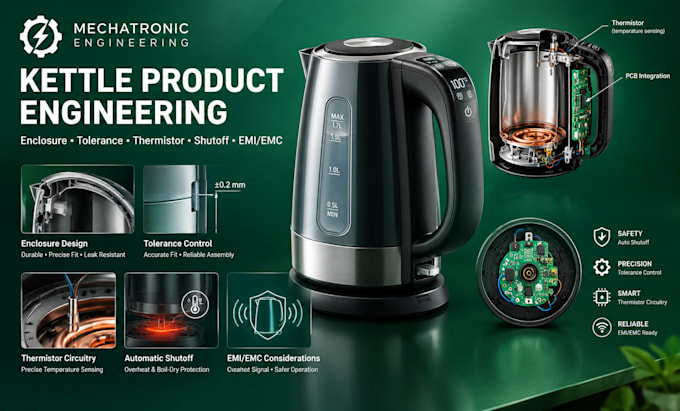
My work links enclosure geometry with heater control, thermistor sensing, automatic shutoff, PCB clearance, tolerance, and DFM.
ENGINEERING CORE:
PRODUCT OUTCOME:
ENGINEERING EDGE:
BUILD FEATURES:
You get connected decisions for the PCB, enclosure, heater, sensing, and build path not disconnected files.
Send your kettle concept, CAD, PCB, or requirements now Let's turn your kettle idea into a buildable product.



Will EMI/EMC problems appear after the PCB is inside the kettle housing?
That risk is considered at the PCB enclosure level, including grounding strategy, cable routing, component placement, switching noise paths, shielding considerations, and separation from sensitive circuitry. This helps avoid discovering interference problems only after prototype assembly.
How do you handle automatic shutoff safely?
I consider the temperature sensing path, control logic, heater switching, fault conditions, and physical separation needed for the shutoff mechanism. The goal is to reduce unsafe heating scenarios and make the control architecture easier to validate.
Can you build the thermistor circuit around real kettle temperature behavior?
Yes. The thermistor arrangement can be considered around temperature sensing, placement, response, electrical limits, and heater-control interaction rather than treating the sensor as an isolated component.
Will the kettle enclosure actually fit the PCB, heater, wiring, and internal parts?
Yes. I account for component clearances, wall thickness, mounting points, cable paths, sealing areas, and assembly access so the enclosure is not merely a nice-looking shell that fails when the hardware is installed.
How do you prevent tolerance problems between the enclosure parts?
I establish critical mating dimensions, clearance zones, fit allowances, and tolerance relationships around the parts that actually matter. This helps prevent loose covers, forced assembly, interference, and misaligned components.