Browse categories
Explore
Fiverr Pro
English
$
USD
Are you losing money to slippage because your TradingView webhooks are too slow? Are your Python scripts freezing when market volatility spikes?
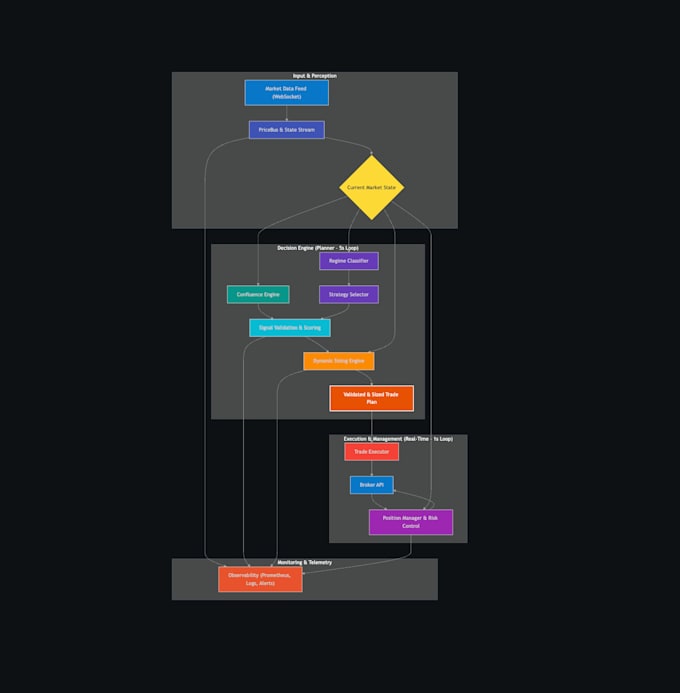
I am a Quantitative Systems Architect. I build low-latency, institutional-grade algorithmic trading engines in Python. Most retail developers write basic sequential scripts that block during API calls. I build asynchronous, lock-free infrastructure.
What I engineer:
Whether you need a simple webhook bridge or a massive quant infrastructure, I engineer it to survive live market conditions.
Please message me before placing an order so we can discuss your broker.

Platform:
Custom
Development technology:
Python
•
Cpp
•
Node.js
Do you provide the trading strategy?
No. You provide the trading logic (Entry, Exit, Risk parameters). I build the high-performance infrastructure to execute your mathematical logic flawlessly.
Which brokers and data feeds do you support?
I integrate with any platform offering a robust REST/WebSocket API. This includes Tradovate, Interactive Brokers, Zerodha (KiteConnect), Alpaca, Databento, and major crypto exchanges.
Why shouldn't I just hire someone to build a $50 bot?
A $50 bot uses simple while-True loops that freeze during network requests, causing massive slippage and missing trades. My engines use the Actor Model and Numba JIT compilation for asynchronous, zero-latency execution. You are paying for institutional reliability.
