Browse categories
Explore
Fiverr Pro
English
$
USD
PCB Power Electronics Expert BMS SMPS LED Drivers DC DC Converter
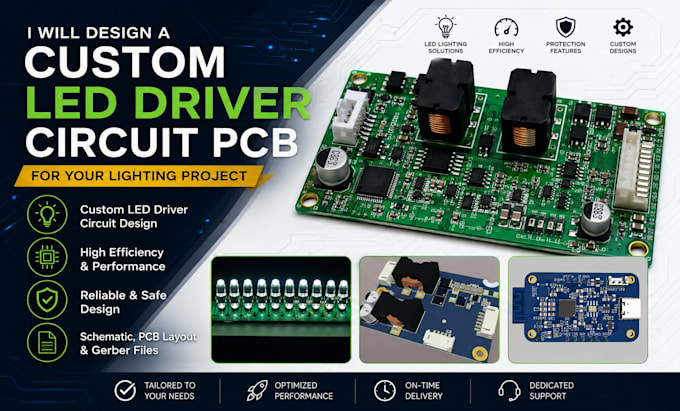
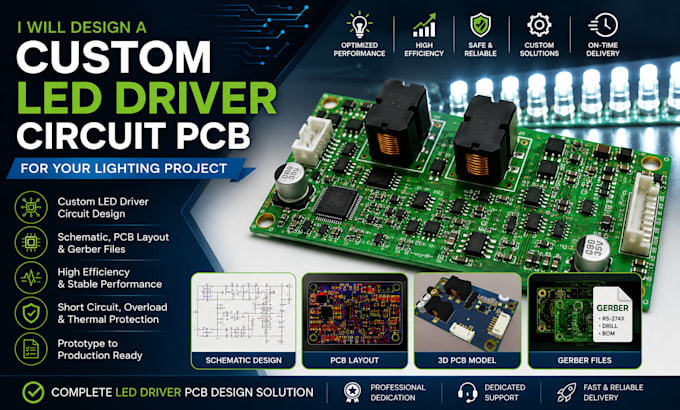
Need a reliable LED driver circuit for your lighting project? I design custom constant-current or constant-voltage LED drivers tailored to your power source, LED specs, and dimming needs from simple single-channel drivers to advanced multi-channel systems.
With hands-on experience in power electronics and PCB design, I deliver efficient, manufacturable circuits for signage, automotive lighting, grow lights, and architectural lighting.
What you get:
I work with Altium, KiCad, and Eagle, following best practices for thermal management, EMI reduction, and efficient current regulation.
Message me before ordering with your LED specs (voltage, current, quantity) and power source so I can confirm the right approach!
What LED voltage/current ranges can you design for?
I can design for most common ranges (e.g., single LEDs up to high-power arrays). Share your LED specs and I'll confirm feasibility.
Do you support dimmable LED drivers?
Yes, PWM and analog dimming are available on Standard and Premium packages. Let me know your dimming method preference.
Can you design drivers for AC mains input?
Yes, I can design both AC-DC LED drivers (mains-powered) and DC-DC drivers (battery/low-voltage input); just specify your input source.
What's the difference between constant current and constant voltage drivers?
Constant current drivers are ideal for most LEDs (better longevity, consistent brightness). I'll recommend the right topology based on your LED type.
Do you provide thermal design guidance?
Yes, thermal considerations are included in Premium package; heatsinking recommendations and layout optimization for heat dissipation.