 August 3, 2026
 7 minute reading
An LLC, or limited liability company, is a US business structure that shields owners' personal assets from business debts and lawsuits while offering flexible management and tax options. It combines the liability protection typically associated with a corporation with the operational simplicity of a partnership or sole proprietorship.
According to the U.S. Census Bureau, new business applications have stayed at historically elevated levels in recent years, with more than 530,000 applications filed nationwide in June 2026 alone. The LLC remains the structure of choice for much of that activity, thanks to the balance it strikes between liability protection, tax flexibility, and manageable compliance.
This guide covers what an LLC is, how it compares with other business structures, and where to get professional help and advice when setting it up.
What Does LLC Mean?
LLC stands for limited liability company. In plain terms, it's a legal business entity that exists separately from the people who own it, known as members. That separation is what creates the "limited liability" in the name. If the business takes on debt or faces a lawsuit, members' personal assets, such as their homes, cars, and savings, are generally protected.
An LLC is formed and governed at the state level, which means the exact rules, fees, and paperwork depend on where the business is registered. Because formation requirements vary so widely, many companies look for state-specific guidance once they've decided an LLC is the right structure for them.
Key Characteristics of an LLC
A handful of features define how an LLC operates day to day:
- Members: An LLC can have one owner (single-member) or multiple owners (multi-member), with no restriction on the number or type of members.
- Limited liability protection: This is the defining feature of the structure, keeping business obligations separate from members' personal finances.
- Operating agreement: This internal document outlines ownership percentages, management roles, profit distribution, and voting rights. Some states require it; even where it's optional, it's considered a best practice.
- Management structure: LLCs can be member-managed, where owners run daily operations, or manager-managed, where designated managers handle operations on the members' behalf.
- Pass-through taxation: By default, the IRS treats single-member LLCs as disregarded entities taxed like sole proprietorships, and multi-member LLCs as partnerships, so profits and losses pass through to members' personal tax returns. LLCs can elect corporate tax treatment if that better suits the business. Tax rules vary based on ownership structure, so professional advice is worth getting before making any decisions.
LLC vs. Other Business Structures
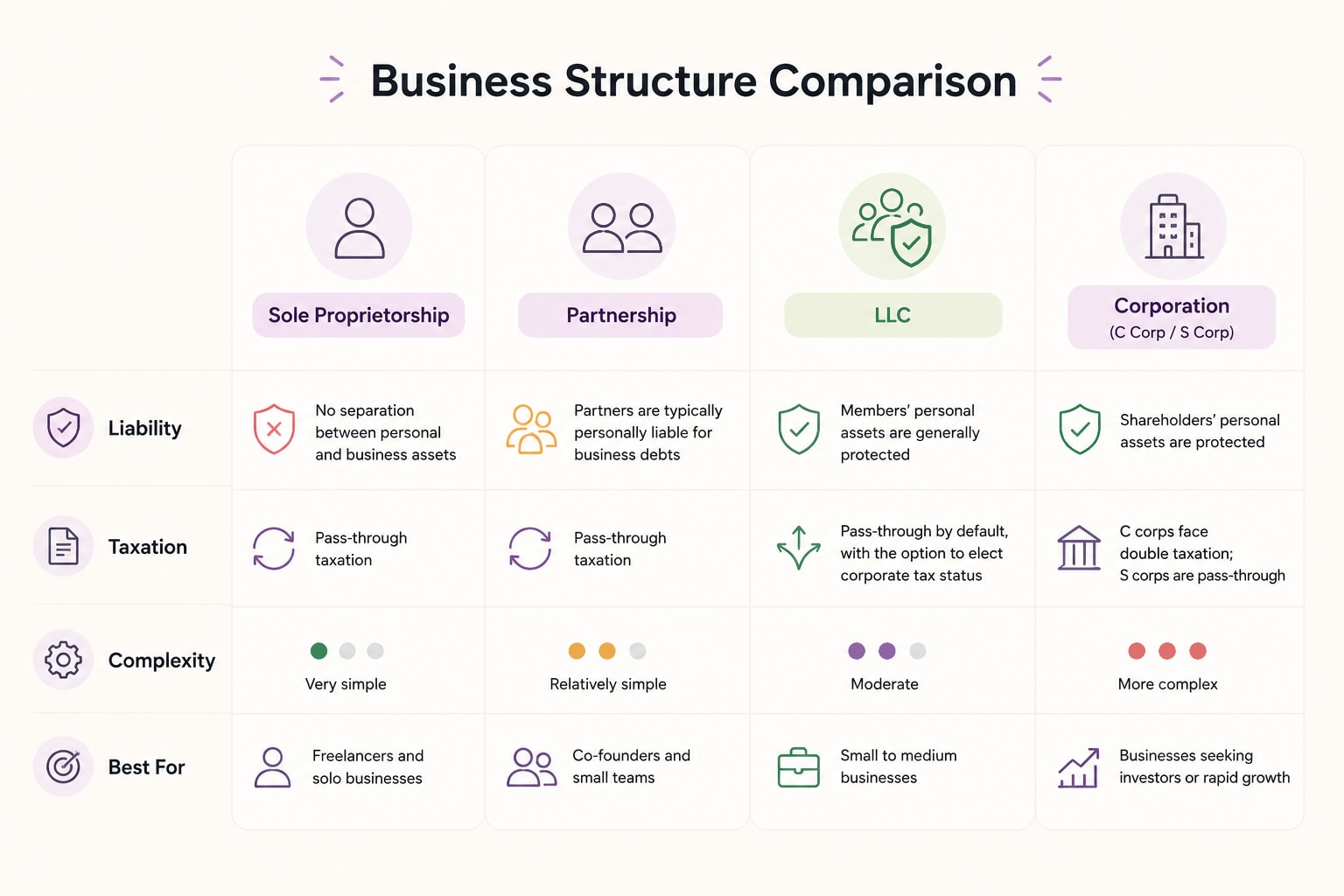
Choosing a business structure often comes down to how much liability protection, tax flexibility, and formality a company needs. Here's a quick comparison:
Structure
Liability
Taxation & Formality
Sole Proprietorship
No separation between personal and business assets
Pass-through taxation, simplest structure to run
Partnership
Partners are typically personally liable for business debts
Pass-through taxation, minimal formality
LLC
Members' personal assets are generally protected
Pass-through by default, with the option to elect corporate tax status
C Corporation (C Corp) and S Corporation (S Corp)
Shareholders' personal assets are protected
More formal compliance requirements; C corps face double taxation
How Is an LLC Formed?
While the exact process varies by state, forming an LLC generally involves the following steps:
- Choosing a business name that complies with state naming rules
- Filing the Articles of Organization (sometimes called a Certificate of Formation) with the state
- Paying the required state filing fees, which vary by state
- Designating a registered agent to receive legal and government correspondence
- Drafting an operating agreement to define ownership and management
Because filing requirements, fees, and timelines differ from state to state, it's worth reviewing the specific process for where you plan to register your business.
Advantages and Disadvantages of an LLC
Advantages
- Limited liability protection for members' personal assets
- Tax flexibility, including the option to elect S corp or C corp tax treatment
- Simpler compliance requirements compared to a corporation
- Added credibility and legal separation between personal and business finances
Disadvantages
- Members may owe self-employment taxes on business income
- Formation costs, fees, and rules vary significantly by state
- Generally less attractive to outside investors than a corporation, since LLCs can't issue stock
- Multi-state operations can add complexity to compliance
Is an LLC Right for Your Business?
The right structure depends on your business's size, industry, growth plans, and tax goals. Small businesses make up the vast majority of US companies. The SBA Office of Advocacy reports more than 36 million small businesses nationwide, accounting for nearly half of private-sector employment, and many of them operate as LLCs. Freelancers, small business owners, and growing teams often choose an LLC because it balances liability protection with manageable compliance. Businesses planning to raise significant outside investment may eventually outgrow an LLC and consider incorporating instead. Either way, getting the formation right from the start matters, since mistakes in filing or in the operating agreement can create complications down the line.
Get Your LLC Set Up the Right Way
Forming an LLC involves legal paperwork, state-specific rules, and decisions that can affect your taxes and liability for years to come. Fiverr connects you with freelancers who specialize in LLC registration, from filing your Articles of Organization to obtaining an EIN and staying compliant after you launch. Compare freelancers by reviews, turnaround time, and package options to find the right fit, whether you need a single filing handled quickly or ongoing support as you grow.
Find a business registration freelancer on Fiverr today and get your business off to the right start.
Register Your Business Correctly
Get help with setting up your LLC from a top-rated freelancer.

FAQs
An LLC, or limited liability company, is a US business structure that creates a legal separation between a business and its owners. It protects members' personal assets from business debts and lawsuits while offering flexible, pass-through tax treatment.
Related Guides



About the author
Eliran LaniadoHead of Business Services
Eliran Laniado is a Vertical Business Manager at Fiverr, leading the e-commerce vertical with a focus on growth, strategy, and category development. He drives partnerships and go-to-market initiatives that connect e-commerce businesses with top freelance talent on the platform.
