 August 3, 2026
 9 minute reading
Every business needs to secure clients to grow. However, you can't assume that clients will just show up at your doorstep and offer you money to work for them. Instead, you may often find that you need to go through a formal process to sell products or secure projects. Also, you may need to write business proposals to form partnerships or secure the loans, grants, or investments you need to launch or evolve your company.
Writing business proposals can be an arduous and time-intensive process. It's not something you can afford to leave to chance. To achieve the best results, it's crucial to know the fundamentals of business proposal writing. Although these business documents can have varied purposes and forms, there are several essential components that appear in many of them. Once you master the basics, you can adapt more readily to new opportunities and write winning documents.
This guide will walk you through the important steps to build your business proposal development know-how. You'll learn about types of business proposals, gain expert writing tips, and understand the must-have components for every proposal. Also, you'll find out how to craft abstracts and cover letters that motivate audiences to want to read more. These proven practices will empower you to create standout documents that fuel the next chapter in your business's growth.
Here is everything you need to know for writing a winning proposal letter
1. What is a proposal letter?
Solicited vs. unsolicited proposals: what are the differences?
Solicited proposals
- Request for proposal (RFP)- An RFP is best when organizations have a need and want respondents to offer solutions to meet their requirements. In response, you'll propose an approach for accomplishing the client's goal along with your pricing.
- Invitation for bid (IFB)- Organizations use IFBs when they have a clear scope of work and want potential suppliers to compete for the contract award. Your bid should demonstrate that you can handle the work at hand for the price you propose.
- Request for quote (RFQ)- When organizations have a precise need for goods or services and want potential vendors to compete on price alone, they may issue an RFQ. Since contract awards often go to the lowest bidder in these scenarios, you'll want to offer a competitive price.
- Your action plan for addressing the issue
- Your anticipated timeline for completion of work
- Background information on your business and key personnel assigned to the project
- How much you expect the project to cost
Unsolicited proposals
2. When do organizations use proposals?
- Bank loans: If you're seeking a loan from a financial institution, you often need to put together a proposal. A bank loan proposal usually details the amount of money you are requesting, how you plan to repay the loan, and what your business will do if you can't repay the loan.
- Funding requests: In addition to loans, you could seek funding through grants or investors. Typical elements of funding requests include a description of the need, a plan for how you will use the funds, and the outcomes you expect to achieve.
- Startups: Emerging companies frequently need to write business proposals to secure the funds they need to fuel growth. Thorough project plans, company financials, marketing and sales objectives, and operational structure are critical components of these documents.
- Restaurants: Like other businesses, restaurants may need to write business proposals for loans or investments to support their launch efforts. As restaurants grow, they may create offers for event catering or bids for securing space for new locations.
- Provision stores: Provision stores, which sell clothing or other necessary goods, may need to write proposals to secure funding or lease space in new venues as they start and expand.
3. Examples of business proposals
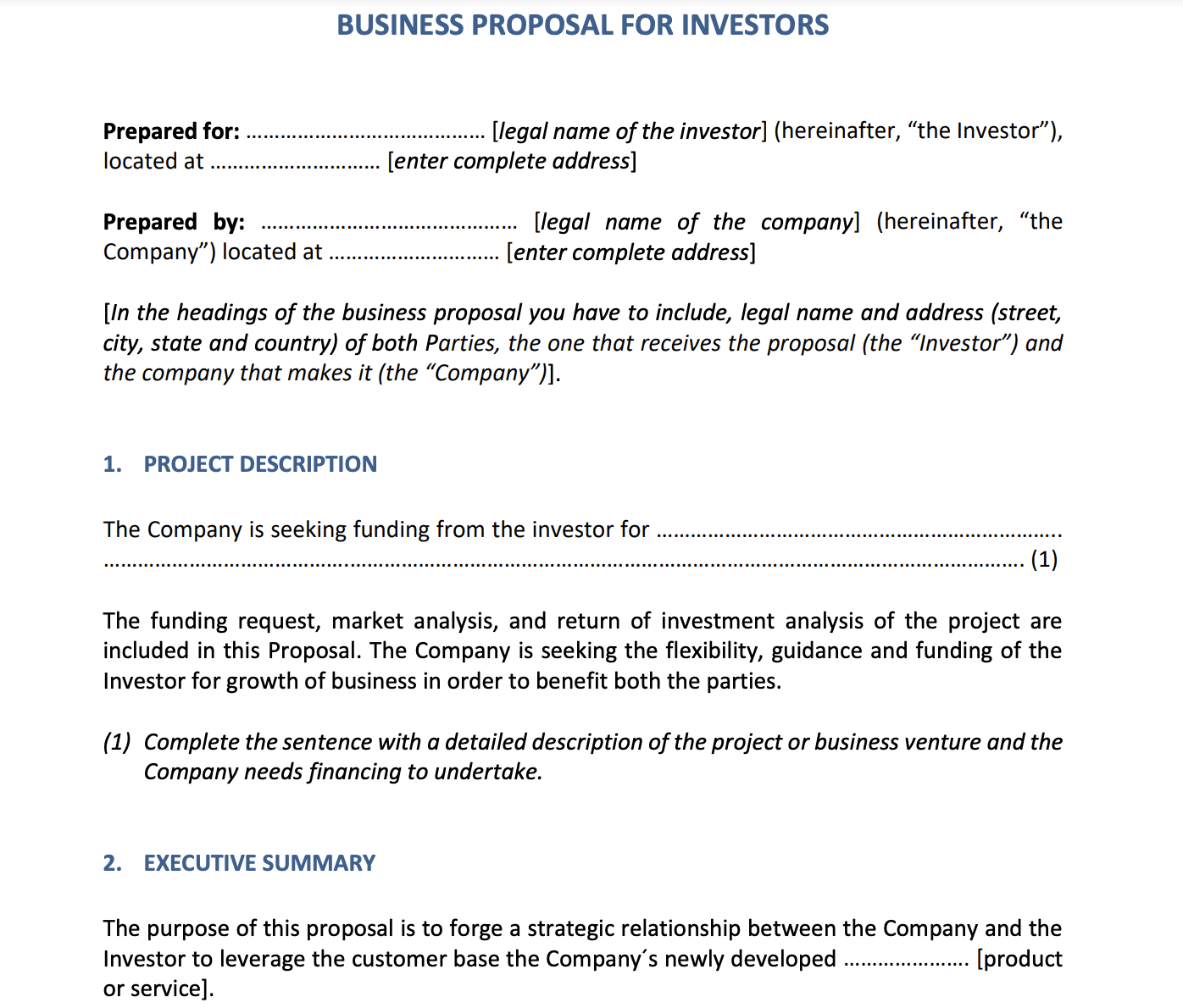
Writing a business proposal for investors
- Introduce the opportunity. Your introduction should describe the investment opportunity and delineate company details such as mission, goals, team members, and location. Include an overview of the marketplace and competition.
- Provide project and financial details. Describe the project(s) funded by any investments in detail. Offer a thorough financial plan, list resources you have and need, and outline the milestones you'll use to chart progress.
- End on a strong note. Wrap up your document with a strong conclusion. Detail how you'll put investment funds to use and recap your project cost estimates. Note any supporting documents for your proposal, which can include anything from your business plan to engineering schematics to endorsements from past clients and/or investors.
Writing a proposal for business partnership
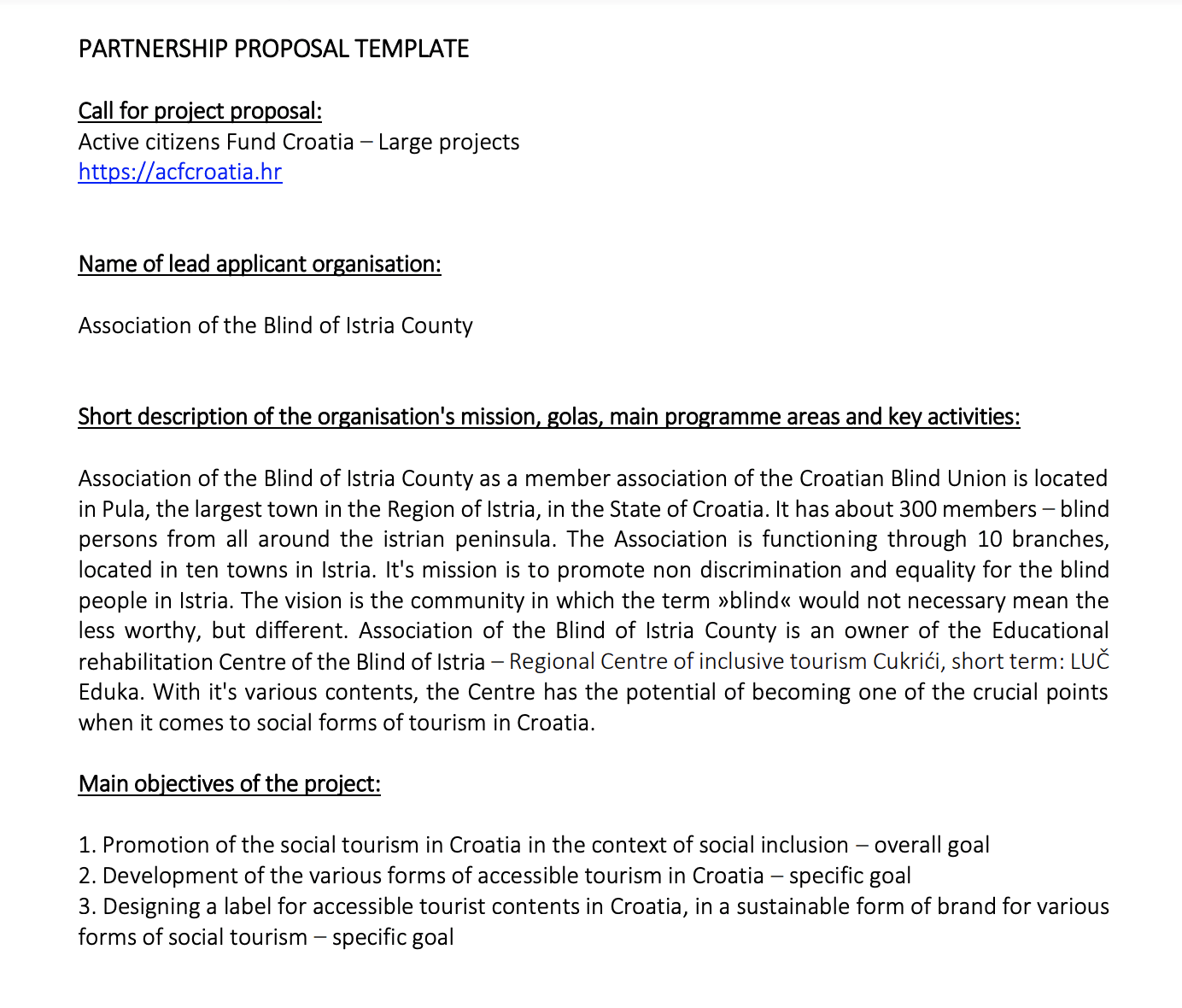
- Be professional and align with your audience's processes. Use professional language and keep your document focused on the business value of the potential partnership. Before sending an offer, investigate the company to determine if they have a formal partnering application or process that should guide your content.
- Introduce your business. Quality partnership proposals start with an introduction to your business. Explain the company's experience, key accomplishments, and unique selling proposition.
- Communicate the value you offer. After your introduction, identify the problem or business need and how the relationship will benefit your partner. Even if you have needs that you're looking for a partner to fulfill, focus your document on the value to the other party. For example, if you're looking for a partner to expand your geographic footprint, note what your partner will gain. Can you introduce them to new markets or clients? Do you have a strong advertising program that can help them build awareness? Point these assets out in your partnership proposal.
- Close with a strong summary. Wrap up your proposal with a compelling summary that reinforces the benefits of the partnership. Highlight statistics and data that prove your capabilities, then close with a strong CTA. Make it clear that you want the prospective partner to take the next step by suggesting an exploratory meeting or call.
Writing a grant proposal for small business
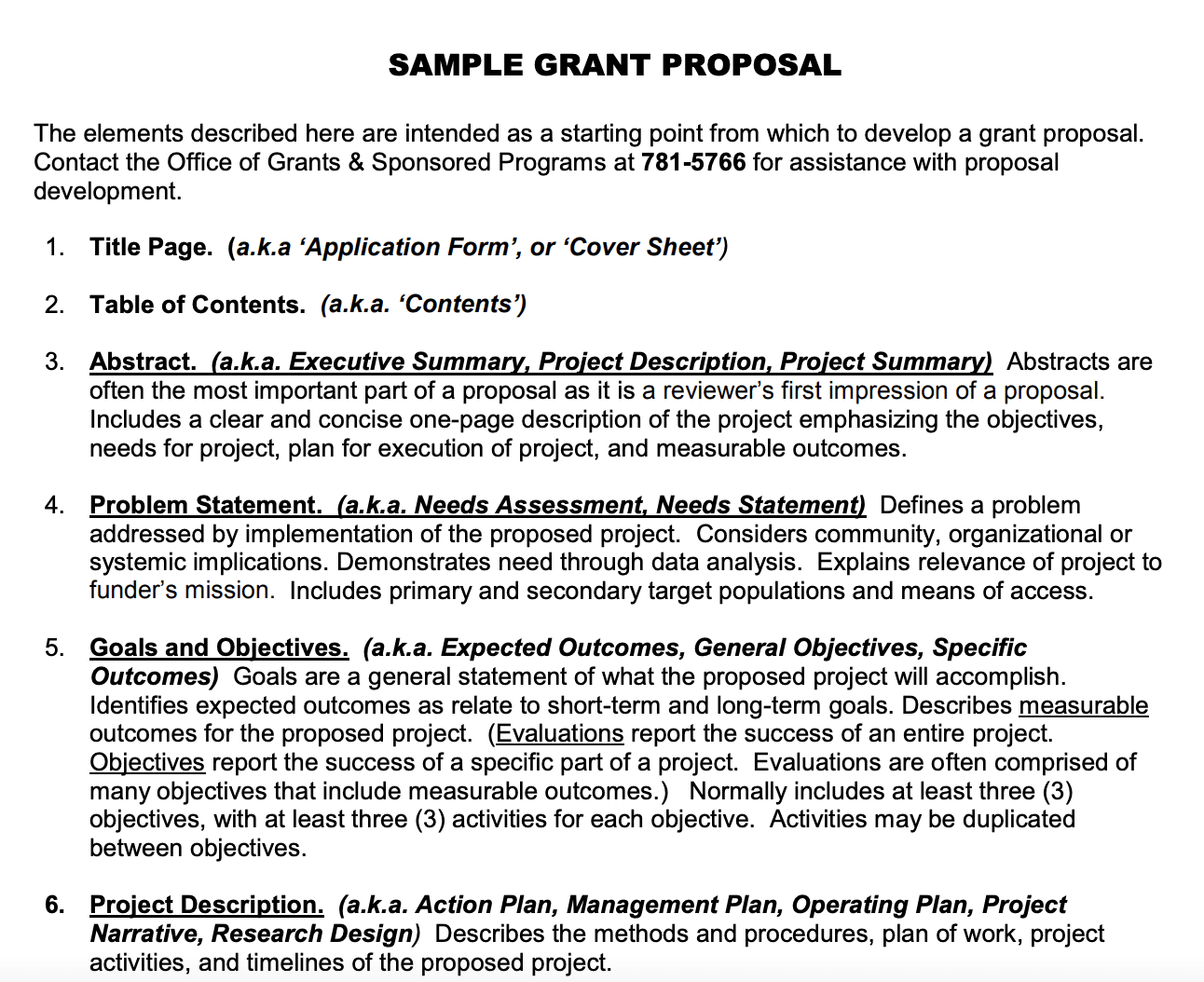
- Start with an attention-grabbing introduction. Like other proposal types, grant documents should start with a compelling summary, which you can often deliver via a cover letter. In your cover letter, explain why the specific grant you are seeking is a good match for your business or the project you plan to pursue instead of making a generic funding request.
- Help readers navigate your document. To help guide reviews through your document, including a detailed table of contents. Add an executive summary that conveys the key points of your document. After your summary, you can include a problem statement or statement of need. This section explains why you are requesting the funds and how you plan to use them.
- Describe expected results and how you will achieve them. Most organizations that provide grants seek to fund specific projects with clear objectives and potential outcomes. Your project description should state exactly what you hope to achieve with your grant funding. In addition, you must include your project management plans and timelines to demonstrate that you can put funds to appropriate use. Provide details on staffing to assure the granting entity that you have the right team in place to achieve your project goals.
4. How to write a proposal, step-by-step
- What problem they are trying to solve?
- What are their objectives?
- What are they looking for?
- How can your offer benefit them?
- state the problem the organization needs help solving
- propose a solution
- offer pricing structure
- Start with a title. Your title should clearly identify the problem or business need you intend to solve.
- Include a table of contents. Created at the end of the writing process, your table of contents helps reviewers navigate through sections of your document.
- Write an abstract or executive summary. This brief summary of your content appears at the front of the document and lets reviewers know what to expect.
- List benefits. Tell clients how they will benefit from your products, services, or solution.
- Explain why the client should choose you. Clearly articulate that you understand the client's problem and show them how you intended to solve it. Clarify your proposed solution in detail.
- Share pricing. Tell clients exactly what they will pay for the products or solutions you are proposing. You may want to include several options and pricing scenarios to give them a choice.
- Include terms and conditions. Proposals typically include a list of relevant terms and conditions (T&Cs). Your T&Cs may include delivery, invoicing, and payment terms, along with materials and information you may need from the client to perform the work described.
- Add a signature box. Always sign your offer and include a space for clients to sign as well. This approach lets clients endorse your document quickly if they agree to the terms you outline.
5. How to write an abstract for a proposal
What is an abstract for a proposal?
The six steps to writing a business abstract
- List the key points in your document and fundamental facts about your business. Focus on benefits to your proposal recipient.
- Summarize how your approach solves the recipient's problems. Don't hide details to entice reviewers to read further.
- Brainstorm phrases that someone may use to find information located throughout your content. Include these in your business abstract where appropriate.
- Create the first draft and let it sit for a few days to a week, if possible.
- Read your complete business proposal, then come back to your abstract draft to refine it. Make sure it conveys the critical points of your proposal.
- Have someone review your abstract and incorporate their feedback before submitting your proposal.
Best practices for writing an abstract
- Ensure that the abstract conveys all the essential points covered in your business proposal
- Keep your abstract concise and focused with no more than 250 to 500 total words
- Include headings and subheadings for readability
- Write at least two sentences for every problem, objective, and method
- Avoid using 'weasel words’ such as "could," "should," or "may," as these can imply that you lack confidence in your business or approach
6. How to write a proposal cover letter
- Include your name and contact information in the header
- Address your cover letter to the actual person who will be reading the letter
- Grab the reader’s attention right away
- Share your background and professional credentials
- Convey your interest in the proposed project and in building a working relationship with the potential client
- Sum up with a clear conclusion
- Add a signature to every cover letter
Find a cover letter writer for hire






Level 2
I will write your petition cover letter for eb1 and eb2 niw
Offers video consultations





























































Level 2
I will make a graphical sponsorship request letter, or fundraising donation letter
Offers video consultations







Level 2
I will write expert opinion or recommendation letter for USA immigration
Offers video consultations






Seven tips for writing a winning business proposal letter
- Outline the major sections. At times, your potential client may offer very detailed guidance on how to structure your document. In other scenarios, you may have a blank slate. Either way, start with an outline that identifies sections and key points you want to make in each one.
- Keep it simple. Although it's tempting to want to showcase your knowledge with long, complex sentences, remember to focus on readability. Your target audience may be reading through dozens of dense documents in a short span of time. Use clear language and effective, short sentences.
- Let your company's personality shine. Often, potential clients aren't just looking for products and services. They're looking for a relationship with a partner they can trust. Let them know what makes your business unique and how working with you can benefit them.
- Include compelling, quantitative data. Reviewers want to see that you have the right knowledge and experience to get the job done — facts and data can make the case. Whenever possible, explain how your products or services delivered a measurable return on investment (ROI) for past clients. Use data to show how you have helped clients save money, increase revenues, and improve operational processes.
- Use a call-to-action. Your proposal should inspire reviewers to move forward. Sometimes, they dictate the process, but you can also help drive them to take the desired next step with a clear call-to-action (CTA). Tell the potential client exactly what you want them to do next, whether that means progressing your offer to the next round or awarding you a contract.
- Give a deadline. It's frustrating to put in the time and effort to develop a proposal and never hear back. If you don't give your prospects a clear deadline, they may keep your offer under consideration and never make a decision. Provide a response date and compelling reason to engage, such as a need to reprice or reset timelines after your deadline.
- Get it to proofread. Proposal reviewers analyze every word. If your document has spelling and grammar mistakes, these errors make you seem less capable. Investing in a professional proofreader can help avoid these unwanted gaffes so you can make an excellent impression. Find experienced freelance proofreaders who can help put the finishing touches on every business proposal.
Find a proofreader for hire




Top Rated
I will expertly proofread copyedit in german, spanish, french, english
Offers video consultations


Level 2
I will provide expert level proofreading with grammar in english
Offers video consultations

Top Rated
I will check your spelling and grammar and proofread and edit your writing
Offers video consultations






































Vetted Pro
I will edit any size book or any other original work for you
Offers video consultations












Top Rated
I will professionally edit and refine your chatgpt and ai content
Offers video consultations





Vetted Pro
I will manually rewrite and improve your content with expert article rewriting
Offers video consultations

Vetted Pro
I will copy edit your script and take it to the next level
Offers video consultations













Standout proposals can accelerate your business growth and success
- Start with the basics. To develop winning proposals, you need to start by understanding what a business proposal is. It's important to keep your audience's needs and benefits in mind when authoring any type of proposal. Don't make your proposals all about you, but do highlight your qualifications and accomplishments to prove your value.
- Understand solicited and unsolicited proposals. It's vital that you know the difference between solicited and unsolicited proposals. Although you'll cover the same territory, solicited proposals have a specific need or purpose in mind. Unsolicited proposals are a type of marketing or sales vehicle that positions what you do directly in front of high-potential prospects.
- Know how business plans differ from proposals. Even if you're a pro at business planning, you should know that a business proposal requires a different set of skills. You may use some element of your business plan in a proposal — or include your plan as an addendum for your investment proposals. You should know the fundamental differences between these two high-value types of business documents, however.
- Learn essential writing techniques. You should also familiarize yourself with essential writing techniques and know the elements of various types of business proposals. Sales offers are distinct from investment, partnership, and grant proposals. Each style of a document can feature different content that you must include and require you to write in different voices. Packaging your proposals with clear abstracts and professional cover letters can help you make an impeccable impression from the first words of every proposal.

Related Guides




About author
Michael Keenan
Michael is a marketer and entrepreneur living in Guadalajara, Mexico. Through storytelling and data-driven content, his focus is on providing valuable insight and advice on issues that readers care about most.
