 September 9, 2026
Generative AI took the world by storm in late 2022 when OpenAI launched ChatGPT. Suddenly, it was possible to write entire articles and business plans using artificial intelligence.
ChatGPT was the world’s first widely accessible and usable large language model (LLM). It could only process text, but its companion DALL-E could generate images from text prompts.
Since then, many more generative AI tools have hit the market, causing some confusion about what generative AI is compared to LLMs.
We’re here to answer that question.
At a glance: LLM vs. generative AI
- LLMs are a subcategory of generative AI, focused specifically on understanding and generating text.
- Generative AI is the broader category, covering text, images, audio, video, and code through models like GANs, VAEs, and diffusion models.
- Every LLM is generative AI, but not every generative AI tool is an LLM, since many generate non-text content instead.
- Newer models are becoming natively multimodal, processing formats like text and images within a single system instead of routing to separate tools.
- Fiverr connects businesses with specialists in prompt engineering, AI integrations, and generative AI tools for projects of any scope.
What is Generative AI?

Midjourney
Generative AI refers to artificial intelligence systems that create new content, such as text, images, audio, video, or code, by learning patterns from existing data. These systems generate outputs that mimic or expand upon their training data.
Generative AI typically relies on various advanced machine learning models to produce its outputs, such as:
- GAN (generative adversarial networks): A deep learning architecture that pits two neural networks against each other to produce new content.
- LLMs (large language models): An AI model designed to process, understand, and generate text.
- VAEs (variational autoencoders): A generative model designed to generate variations in data.
- Diffusion models: A type of model used predominantly in image and audio generation that denoises random data to generate output.
Examples of generative AI tools include ChatGPT, Grok, Windsurf for coding, Midjourney for image generation, and ElevenLabs for AI-generated voiceovers. Businesses looking to apply generative AI at scale can connect with specialized AI experts through Fiverr Pro to implement the right tools for their use case.
What are Large Language Models (LLMs)?
An LLM is a type of artificial intelligence model designed to understand, process, and generate human-like text.
All mainstream, modern LLMs are based on the transformer architecture, developed by eight Googlers, which was the pivotal breakthrough leading to the current AI boom. Essentially, the transformer architecture allows a neural network to process multiple inputs at the same time, even for extremely large inputs. This allows transformer-based models to process context from a body of text far more accurately than other architectures.
LLMs are trained on massive datasets of text using deep learning techniques, enabling them to perform tasks such as text generation, translation, summarization, and question-answering by predicting the next word in a sequence based on context.
The more valuable the data an LLM has, the better it can answer questions.
Examples of LLMs are Grok by xAI, ChatGPT by OpenAI, Claude by Anthropic, and Gemini by Google.
Many tools use LLM technology in the back-end to power them. For example, AI code generators are typically powered by ChatGPT, Claude, or one of the other popular LLMs. You download the code editor and work with it like any other code editor, but it integrates deeply with an LLM to provide additional AI functionality.
You can also easily integrate LLMs into your own tools through AI integrations, which Fiverr experts can also help you with.
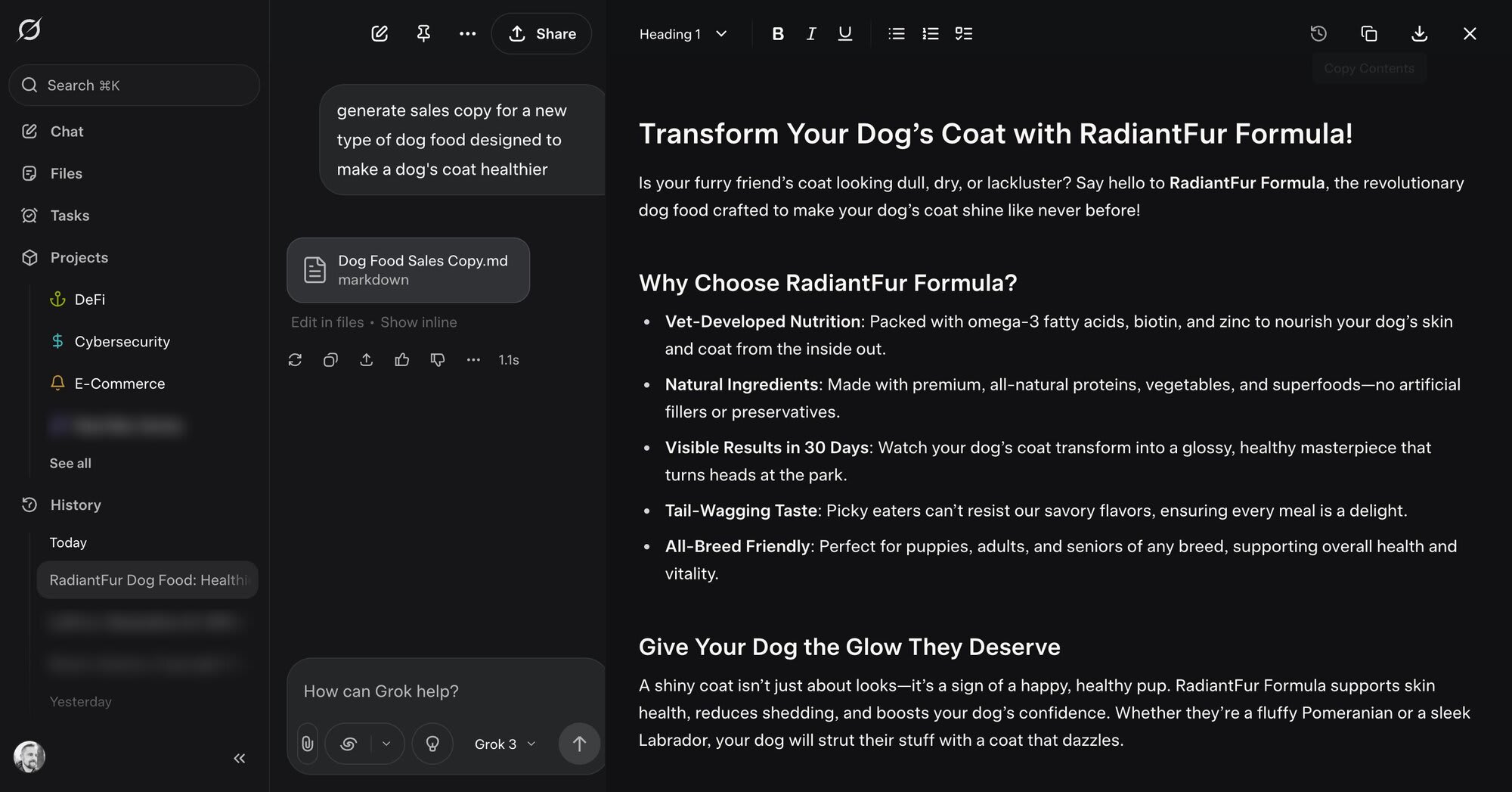
xAI/Grok
Key Differences Between LLMs and Generative AI
LLMs are a subcategory of generative AI. The following are the key differences between these two subjects
Quick comparison: LLMs vs. generative AI
LLMs
Generative AI
Scope
Text (some now multimodal)
Text, image, audio, video, code
Architecture
Transformer-based
LLMs, GANs, VAEs, diffusion models
Applications
Writing, translation, Q&A
Content, image/video gen, music, code
Data needs
Massive text datasets
Massive multimodal datasets
Scope
Generative AI is a broad category that creates diverse content types, including text, images, audio, video, and code.
LLMs can only process and generate text, such as writing, summarizing, answering questions, or translating languages.
LLMs are morphing and becoming “natively multimodal,” now processing inputs in many different formats (modalities) without you having to switch to a separate tool. This is in contrast to the early days of generative AI, when LLMs only seemed multimodal—under the hood, the LLM was still passing any non-text instructions to a second model that could deal with that modality. Now, the same model handles all types of input.
These new models are called LMMs—large multimodal models.
Architecture
Generative AI leverages a variety of models as described earlier, including LLMs. Anything that uses AI to generate content of any type can be used in generative AI, whereas modern LLMs typically only use models based on transformer architecture for text processing.
Applications
Generative AI supports creative tasks of all types. You can use it to write text, generate images, edit images, create videos, prepare an SEO strategy, brainstorm, write a business plan, or create music.
LLMs are limited to text-only tasks, although they do comprise a large portion of the generative AI field. Companies can easily connect to LLMs using an API integration to add text-based AI functionality to their tools. Many such tools exist, from AI coding tools to AI-powered chatbots.
Creating a tool or app that uses an LLM or other generative AI model in the back-end requires only an AI integration expert and professional software development, which you can find on Fiverr.
Data Requirements
LLMs require massive datasets of high-quality text, such as books and news articles. OpenAI trained ChatGPT on internet data, which has unfortunately also led to AI adopting many human biases.
The need for high-quality data in massive quantities is so immense that OpenAI has allegedly scraped copyrighted material from YouTube, The New York Times, and many well-known authors to train its AI.
Generative AI needs even more data because of its multimodality. In addition to text, it needs diverse and massive datasets of high-quality images, video, and audio.
Gen AI vs. LLMs: When to Use Each
LLMs are a part of generative AI, so you’ll always be using generative AI even if you have a text-only project.
Here are some specific use cases for when you’ll need multi-modal generative AI versus a text-only solution.
When to use generative AI
Generative AI produces a wide range of outputs, including images, videos, and music.
Marketing teams might use tools like Midjourney or ChatGPT’s image capabilities to generate custom images for an e-commerce website or to create high-resolution visuals of products in various styles. You can also use these tools to create initial mockups of photos before hiring a professional photographer to do the final shoot, potentially saving thousands on initial costs.
Gaming studios might use tools like Runaway, a generative AI video and image tool, to generate concept art for game environments. Gen AI tools make it easy and cost-effective to iterate on designs before calling in professional game art design for the final version.
Podcasters and video editors can use tools like AudioCraft to generate royalty-free music and sound effects for their shows.
A fashion designer might use a generative AI image generator to create virtual clothing prototypes for a new fashion line, testing patterns and textures digitally before production.
If you’re uncertain what tool to use for a generative AI task, get expert AI consulting from Fiverr to help you.
When to use text-only LLMs
OpenAI still considers its text-only 4.1 model as the superior model across its range, second only to its 4.5 model, which is still in preview mode. Although the 4o model is multimodal, allowing you to quickly switch modalities without switching tools, the text-only model would be the better choice for advanced reasoning and text-based tasks.
As a general rule, choose a text-only LLM for tasks where you’re certain you won’t need to switch modalities, or where you need superior performance on text-only tasks.
LLMs are excellent for generating, editing, or analyzing text. You can use them for writing documents or marketing copy, generating code, or summarizing long reports.
The quality of output is largely dependent on the quality of your prompt, which can sometimes be pages long. You can get help from custom writing prompt experts at Fiverr for this if you need it.
One common use case for using LLMs is customer service chatbots. You can connect these to an LLM and then fine-tune it to use your company’s knowledge base so that the chatbot can handle most customer service queries.
Content creation is another massive use case. You can either use an online chatbot such as Grok or Claude to generate copy or sign up for an AI service that focuses specifically on this.
Any AI-generated content should be tweaked by a human to ensure it’s of the highest quality, and you can get AI content editing services on Fiverr to help you with this.
Software development has benefited immensely from LLMs. Many AI-powered code review tools exist that can check code before it gets committed to a code base. AI coding tools also help programmers write boilerplate code more rapidly than doing it manually. Some popular AI coding tools are Windsurf, Tabnine, and Amazon Q Developer.
The Future of LLMs and Generative AI
Multiple prominent figures have applauded generative AI as one of the biggest tech breakthroughs in history. Oracle co-founder Larry Ellison says it’s “the biggest thing humans have ever invented.” Google co-founder Sergey Brin says it’s “bigger than the internet.”
However, the hype surrounding AI has also been immense.
Every emerging technology goes through a Hype Cycle, according to Gartner. The cycle begins with wild-sounding claims that soon prove untenable, leading to a phase called the “Trough of Disillusionment,” finally resulting in a more sober view of the technology, where people start to recognize the technology’s real use cases.
Gartner has determined that generative AI is now in the Trough of Disillusionment phase, as companies start to discover that it didn’t live up to all the hyperbolic claims, such as the claim that it would take over people’s jobs. Other unrealistic claims included that AI would replace writers and designers. The consensus now is that AI-generated content benefits significantly from human review and editing to reach the quality standards that businesses expect.
AI-native software engineering is currently entering the hype cycle, with hard-to-swallow stories flooding social media about how generative AI is going to take over the software development lifecycle. The claims are largely unsupportable, especially considering generative AI’s tendency to hallucinate, which can lead to catastrophic security flaws and errors in production code.
Always get any AI-generated code reviewed by an expert before putting it into production. However, the code review might take longer than writing the code itself, so the usefulness of fully automated AI coding remains in question.
In either case, AI continues to find use cases across industries, and new technologies continue to emerge that improve its capabilities.
For example, RAG—retrieval-augmented generation—is a technique for fetching data from a knowledge base so that an LLM can provide more accurate answers. You can also fine-tune an LLM or build guardrails to make it less likely to answer in non-compliant ways.
Hallucination and accuracy continue to be massive challenges and likely will never be solved. This makes it unlikely that generative AI and LLMs will ever be adopted fully in highly regulated industries such as health, finance, and the legal sector.
Still, it’s conceivable that AI companies will make progress to improve accuracy so that more industries can adopt generative AI, even if they don’t adopt it fully.
Get Help with AI from Specialists at Fiverr
For businesses or individuals seeking tailored AI solutions, Fiverr Pro offers access to freelance experts skilled in generative AI and LLMs. Whether you need custom model development, prompt engineering, AI integration, or ongoing technical support, Fiverr's global talent pool and vetted AI experts provide specialized services tailored to projects of any scope and complexity.
To get started, open an account on Fiverr today.

FAQs
Generative AI is a broad category of AI that creates various content types, including text, images, and audio.
LLMs are a specific type of generative AI focused on text, using transformer architecture for tasks like writing or conversation.
Related Guides

 10 minute reading




About the author
Ofri DavidAI SEO Specialist
AI SEO specialist at Fiverr who works at the intersection of automation, coding, and GEO to build high-impact, scalable solutions
