 October 7, 2026
 8 minute reading
Choosing where to source design work shapes everything from timeline to budget to how much creative control a business retains along the way. Two platforms dominate the conversation, 99designs and Fiverr.
Both platforms serve real needs, but they operate on fundamentally different models. 99designs centers on design contests, where multiple designers submit concepts for a business to choose from. Fiverr centers on direct hiring, where businesses browse profiles, compare packages, and hire a specific freelancer for a project, whether that's a single design task or an ongoing, multi-month engagement.
This comparison breaks down how each platform works, where each one shines, and how to decide which fits a given project.
Key takeaways: 99designs vs. Fiverr
- The core difference is the model: 99designs runs design contests where multiple designers submit concepts, while Fiverr is a direct-hire marketplace where you choose your freelancer up front.
- Fiverr spans every business category, so a business needing a logo now and a website next quarter sources both from one platform. 99designs is design-only.
- Fiverr supports both a single fixed-price deliverable and an ongoing hourly relationship, which suits businesses whose design needs continue past the first project.
- Direct hiring gives room for back-and-forth feedback and an ongoing working relationship, rather than selecting from blind contest submissions.
- Contests suit a one-off, well-defined deliverable where the visual direction isn't locked in yet and you want several interpretations to compare.
Comparison table: 99designs vs. Fiverr
Category
99designs
Fiverr
Platform model
Design contests: multiple designers submit concepts, business picks a winner
Direct-hire marketplace: browse, compare, and hire freelancers directly
Category scope
Design only (logos, branding, packaging, web design)
All business categories: design, development, marketing, writing, video, and more
Talent pool
Design-specialist freelancers competing per contest
Global freelancer network across every skill and industry
Pricing structure
Fixed contest packages, priced by tier and number of design concepts
Transparent, upfront pricing with flexible options across expertise levels and project scopes
Project flexibility
Best suited to one-off design deliverables with a defined outcome
Supports both short-term tasks and long-term, ongoing collaborations
Selection process
Client reviews multiple submitted concepts and picks a winner
Client reviews portfolios, packages, and reviews before hiring directly
Best for
Clients who want several design directions to compare before committing
Clients who want direct collaboration, broader category access, or a long-term working relationship
A Closer Look at 99designs
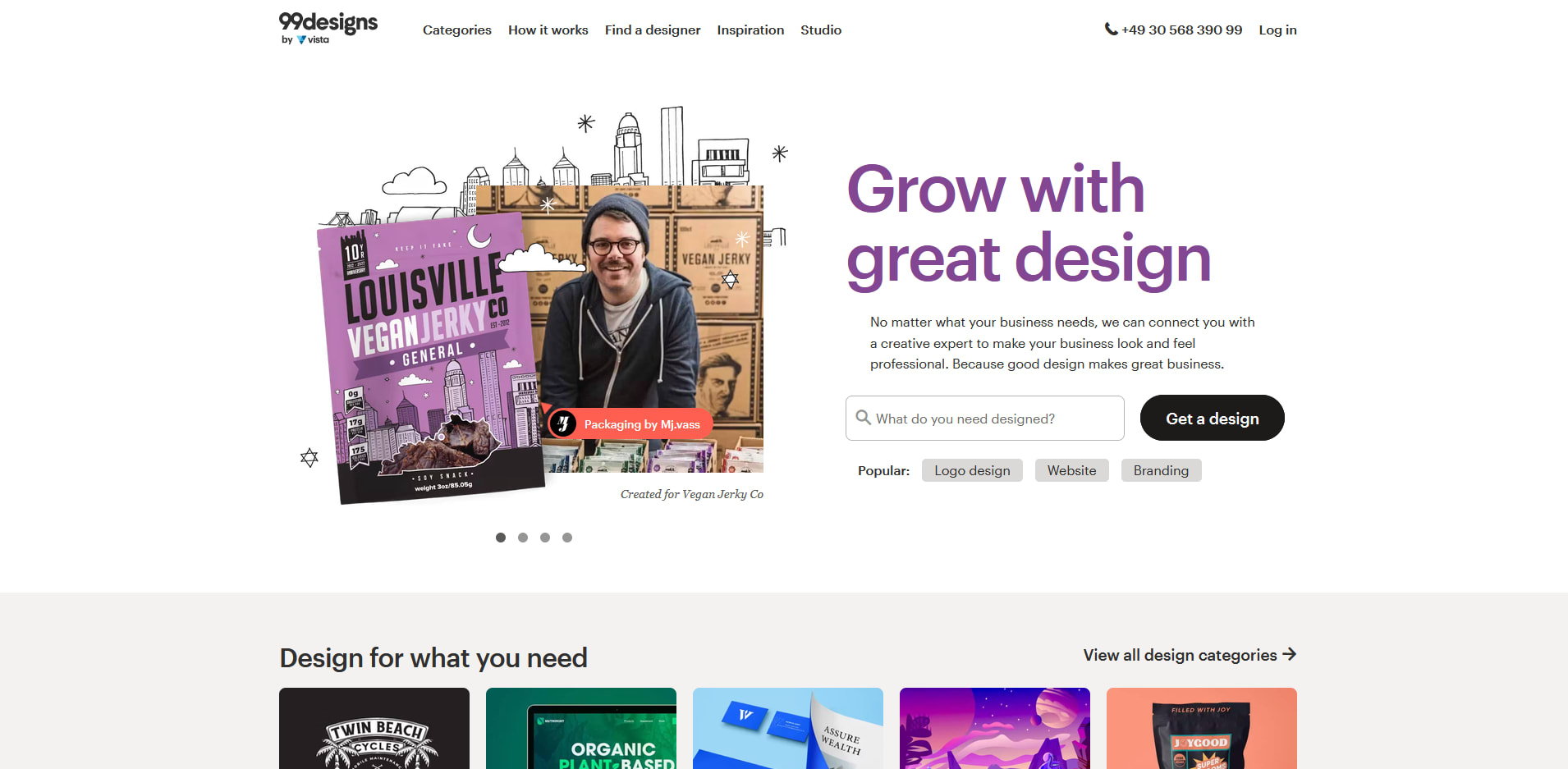
99designs built its reputation on the design contest format. A business submits a creative brief, and multiple designers respond with their own concepts. The business then reviews the submissions and selects a winner, whose design becomes the final deliverable.
Where this model works well:
- Multiple creative directions at once. Instead of evaluating one designer's take on a brief, a business sees several different interpretations side by side, which is useful when the visual direction isn't fully locked in yet.
- Design-specialist focus. Because 99designs is built exclusively around design work, the platform's structure (briefs, packages, contest formats) only functions for design projects like logos, brand identities, and packaging.
- Structured packages. Contest tiers are clearly defined upfront, which gives businesses a predictable framework for what they'll receive.
Where the model has limits worth understanding:
- Scope is limited. 99designs is design-only, so it offers nowhere to turn once a business needs development, marketing, content, or any other non-design work done.
- Less flexibility once a contest launches. The contest structure isn't built for iterative, ongoing collaboration in the way a direct-hire relationship is; it's optimized for a defined deliverable within a set window.
- Costs can accumulate. Running multiple contests or upgrading packages to attract more submissions adds up, especially for businesses that need several design assets over time.
A Closer Look at Fiverr
Fiverr operates on a direct-hire model. Clients search or browse by category, compare freelancer profiles and packages, and hire the professional whose portfolio and pricing fit the project, whether that's a single design task, a full brand identity system, or an ongoing collaboration that spans months.
Where Fiverr stands out:
- Category breadth. Fiverr covers design alongside web development, digital marketing, video production, and dozens of other categories. A business that needs a logo today and a full website build next quarter can source both from the same platform.
- Transparent, tiered pricing. Freelancers publish clear package pricing upfront, so businesses can compare options across expertise levels and project complexity before committing. Development and design projects on Fiverr commonly range from a few hundred dollars for smaller design tasks up to several thousand for full-scope branding or web projects, depending on complexity and the freelancer's experience level.
- Two ways to find the right freelancer. Browse the marketplace and hire directly, or let Fiverr's AI assistant refine your project requirements before matching you with experienced freelancers who fit your needs, budget, and timeline. Either way, clients work one-on-one with a single freelancer from the start.
- Support for both short-term and long-term work. Fiverr's structure accommodates a single fixed-price deliverable just as easily as an ongoing hourly relationship, making it a fit for businesses whose design needs evolve over time rather than ending after one project.
- Direct collaboration and control. Because businesses hire a specific freelancer rather than selecting from blind contest submissions, there's more room for back-and-forth communication, iterative feedback, and a working relationship that continues beyond the first deliverable.
- Transparent quality signals. Reviews, ratings, and delivery milestones give businesses visibility into a freelancer's track record before they hire, and clear checkpoints throughout the project.
Making the Right Choice
The decision often comes down to how a business wants to arrive at its final design and what it needs beyond that first deliverable.
Which platform fits your project
Your project
Better fit
Why
One logo, direction not yet set
99designs
Several concepts to compare side by side
Full brand identity over months
Fiverr
Same freelancer across iterations
Design plus development or marketing
Fiverr
One platform across every category
Needs close back-and-forth
Fiverr
Direct collaboration from the start
Single defined deliverable, fixed window
Either
Contest tiers or a fixed-price package
Clients who want to compare several distinct creative concepts before committing to one direction may find the 99designs contest format appealing, particularly for a single, well-defined deliverable like a logo or brand mark.
Clients who want a direct working relationship, transparent pricing across a wider range of project types, and the flexibility to scale from a single design task into a longer-term collaboration, or to source other business needs from the same platform, will find Fiverr better suited to that broader picture. This flexibility matters most for businesses whose design needs don't end at a single deliverable, whether that's iterating on a brand identity over several months or expanding into web and marketing work down the line.
Ready to Get Started?
Fiverr gives clients direct access to a global network of professional designers, with transparent pricing and the flexibility to hire for a single project or build an ongoing collaboration. Whether the need is a one-time logo design or continuous design support as a brand grows, Fiverr's marketplace makes it easy to browse portfolios, compare packages, and hire the right freelancer directly. Browse designers on Fiverr and find the right fit for your next project.

FAQs
99designs is built specifically around the contest format, making it a straightforward option when a client wants multiple design concepts submitted for a single deliverable like a logo. Fiverr takes a different approach, giving clients the choice to hire a specific designer directly based on their portfolio and reviews or use the freelancer matching tool. Fiverr suits businesses that prefer working closely with one freelancer they’ve chosen from the start rather than reviewing blind submissions.
Related Guides


About the author
Sagi HaimDirector of Business Economics
Sagi is the Economics Director within Fiverr's business department, where he connects top-down corporate strategy to bottom-up execution across the company's strategic plans. He owns success signal definition, learnings quality standards, and corporate KR tracking for initiatives spanning demand generation, fulfillment, and operational excellence, bringing deep expertise in causal inference and applied economics to Fiverr's biggest strategic questions.
