 August 3, 2026
 10 minute reading
Modern businesses depend on data professionals to turn raw information into a working asset. Three roles carry most of that load: data engineers who build the pipelines and warehouses, SQL database developers who design and maintain the systems where data lives, and web scrapers who collect intelligence from the open web. As organizations expand their analytics, automation, and machine learning capabilities, demand for these specialists continues to grow, making informed budgeting more important than ever.
Pricing varies based on project scope, technical complexity, and the specialist's expertise, with typical engagements ranging from focused tactical work to full enterprise architecture. This guide consolidates current marketplace pricing across the three roles, flags figures that may run too low compared to broader market reality, and walks through the cost drivers, project tiers, related services, and ongoing expenses that shape your total investment.
Average Data Professionals Costs
Based on recent Fiverr data, pricing across these three roles shows clear patterns by role and task type. The figures below reflect typical fixed-price averages and hourly bands, with broader marketplace context where source numbers appear too low for skilled work.
Data Engineer Rates
General data engineering services average around $127 for fixed-price projects. Machine learning integration projects average $367, ETL implementations $136, NLP work $295, and DevOps engineering for data infrastructure $167. Data warehouse design starts around $94 for basic implementations, with enterprise solutions priced higher.
Hourly rates run $25 to $75 for machine learning work. Natural language processing averages $30 to $35 hourly, and specialized consulting reaches $100 per hour. For complex pipelines, warehouse architecture, or cloud-native work, vetted data engineers offer pre-screened expertise that scales with project size.
SQL Database Developer Rates
Database development averages $155 per project with hourly rates of $40 to $75. Design and optimization fall around $134 fixed and $40 to $60 hourly. Migration and performance work averages $126, consultation $85 fixed with hourly rates from $40 to $300 for senior strategy work. Entry-level SQL and NoSQL query writing averages $59 per project.
Database administration runs $15 to $25 per hour, though broader market data points to $35 to $75 with a median near $50. Basic SQL and NoSQL query work runs $15 to $25 hourly, though the broader median is closer to $25 with typical engagements at $18 to $40. For schema design, migration, or ongoing optimization, vetted SQL database developers provide reviewed depth on enterprise platforms.
Web Scraper Rates
Data scraping projects focused on extraction average $123 for fixed-price work. Data mining and broader processing tasks average $99. Software development engagements that bundle scraping into custom tooling reach $379, and projects involving browser extensions or specialized tools price closer to $199.
Hourly rates depend on complexity. Entry-level scraping for lead generation runs $15 to $35 per hour, though typical scraping engagements are closer to $20 to $40. Custom scraper development and scripting come in at $20 to $80 per hour, though skilled scripting is closer to $50 to $80.
Advanced specialists handling anti-detection, large-scale automation, or proprietary platforms charge $80 to $120 per hour. Lead generation scraping services can start as low as $50 for basic tasks. For custom scrapers, anti-detection workflows, or recurring extraction at scale, vetted web scraping specialists deliver production-ready solutions.
Which Pricing Model Is Best for You?
Both hourly and fixed-price arrangements work across all three roles, and the right model depends on how clearly you can define the work. Fixed-price packages suit well-scoped deliverables: building a specific pipeline, migrating a database, optimizing a defined set of queries, or extracting a known dataset. Hourly arrangements fit ongoing support, exploratory analysis, evolving requirements, or scraping projects where target sites change behavior frequently. When in doubt, start hourly for discovery, then move to fixed-price once scope is locked in.

What Influences Cost
Several factors shift pricing across all three roles, while others are specific to one specialization.
Technical Complexity and Architecture
Simple pipelines connecting two systems with straightforward logic typically run 3 to 5 days at $100 to $300. Mid-complexity work with multiple sources, custom transformations, error handling, and basic monitoring takes 1 to 2 weeks at $300 to $800. Enterprise-grade architectures with real-time streaming, data quality frameworks, and comprehensive monitoring extend beyond three weeks and often exceed $1,500.
For database systems, schemas with 5 to 10 tables cost $75 to $120, mid-complexity systems with 20 to 50 tables and stored procedures run $150 to $300, and enterprise databases managing hundreds of tables run $500 to $1,500, increasing further with high availability or compliance requirements.
Database Platform and Technology Stack
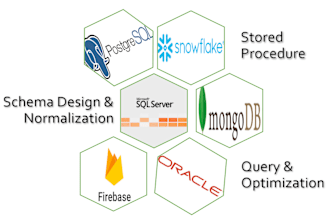
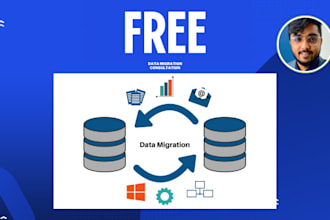
The database management system shapes pricing. Widely adopted platforms like MySQL or PostgreSQL start around $60 to $90 for straightforward projects. Enterprise platforms such as Oracle or Microsoft SQL Server, and specialized systems like MongoDB or Cassandra, command $120 to $200 for the same scope, driven by licensing weight and specialist knowledge. Cross-platform migrations add 30 to 50 percent because they require dual expertise.
For data engineering, cloud platform expertise with AWS, Google Cloud, or Azure adds 20 to 40 percent. Specialized tools like Apache Kafka, Spark, Airflow, or Snowflake command 30 to 60 percent premiums over baseline.
Website Complexity and Anti-Scraping Measures
For web scraping, the structure of the target site is the biggest cost lever. Static HTML sites take 2 to 5 hours of development at $50 to $150 for basic extraction. Dynamic sites built on JavaScript frameworks need 8 to 15 hours and run $200 to $400. Sites with aggressive anti-scraping defenses, CAPTCHAs, or rate limiting can double development time because of proxy rotation, browser automation, and bypass work.
Data Volume and Processing
Small datasets under 100 GB or one-time extractions of 1,000 to 10,000 records sit at the lower cost tier. Medium-scale implementations handling several hundred GB to multiple terabytes with daily or hourly refresh requirements, or scraping 10,000 to 50,000 records, add 30 to 50 percent due to optimization needs and infrastructure considerations. Large-scale real-time systems, petabyte-scale warehouses, or scraping projects exceeding 100,000 records can double or triple baseline costs because of distributed systems expertise and performance tuning needs.
Integration Scope and Legacy Systems
New implementations on modern platforms with standard APIs sit at base rates. Integrating with 3 to 5 existing systems, particularly those with limited documentation or outdated interfaces, extends timelines 40 to 60 percent. Legacy modernization involving mainframes, custom databases, or undocumented data structures can triple project duration because of reverse engineering and extensive testing.
Cost Breakdown by Project Tier
Matching project scope to budget helps you select the right service level for each role. Tier ranges below reflect typical fixed-price engagements across the three roles.
Basic Projects ($75 to $200)
- Simple ETL pipelines connecting one or two data sources
- Basic database schema design or query optimization
- Simple scraping from up to three websites with under 1,000 records
- Standard reporting queries and view creation
- Best for startups or single tactical improvements, delivered in 2 to 5 days
Intermediate Implementations ($250 to $800)
- Multi-source data integration with transformation logic
- Cloud data warehouse setup and configuration
- Custom database design with normalized structure and indexing
- Custom scrapers covering 3 to 10 sites with 10,000 to 50,000 records
- Automated workflow orchestration and basic monitoring
- Best for growing companies establishing scalable infrastructure, 1 to 2 weeks
Advanced Enterprise Solutions ($1,000 to $3,000)
- Real-time streaming platforms and complex data lake architectures
- High-availability database systems with security and compliance frameworks
- Sophisticated multi-source scraping with anti-detection and database integration
- Machine learning pipeline infrastructure and data quality systems
- Best for enterprises with mission-critical data operations, 3 weeks or longer, with complex engagements running higher based on scope and integration depth
Related Services That Impact Overall Costs
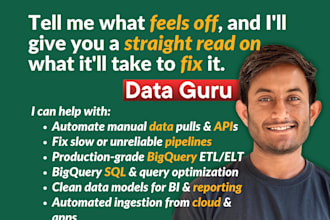

Level 2
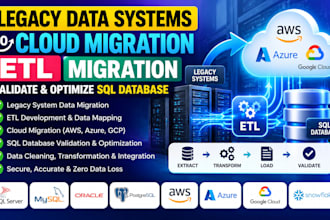
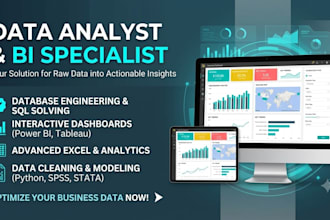
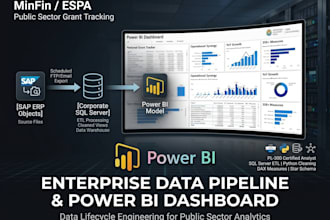
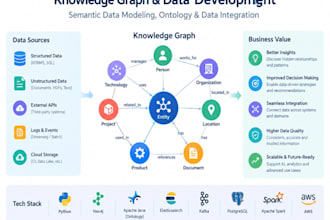
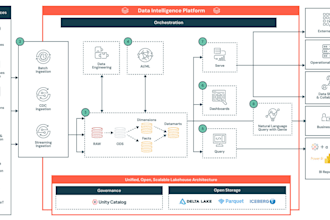
I will build data engineering, api, extraction, python, sql, etl projects
Offers video consultations


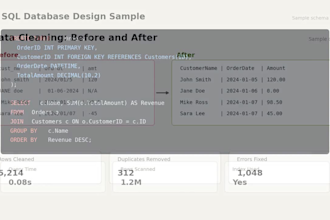

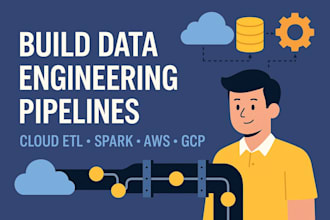

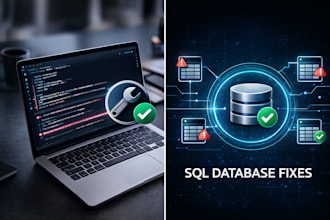

















Level 2
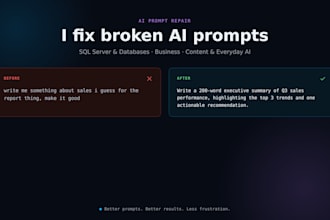
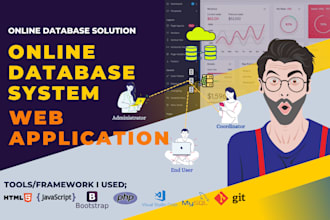
I will help you with sql databases, queries, and applications
Offers video consultations















Level 2
I will build custom PHP applications, sql databases and PHP tasks
Offers video consultations

















Data and Database Consulting
Strategic engagements that map your architecture, recommend technologies, and produce an implementation roadmap typically run $150 to $400 depending on depth. This upfront investment often prevents far more expensive architectural rework downstream. Organizations benefit most from this guidance when planning major modernization initiatives, selecting new platforms, or addressing persistent performance issues that require expert diagnosis.
Database Administration
Ongoing administration covering system health, backups, performance monitoring, and security patches runs $150 to $300 monthly for small to mid-sized systems, with enterprise arrangements going higher. Companies need this service when they lack in-house expertise or when database criticality demands dedicated attention to prevent downtime and data loss.
Cloud Infrastructure and DevOps
Provisioning, containerization, CI/CD pipeline setup, and deployment automation add $150 to $400 to project costs. Most data engineering work in 2026 assumes this layer is in place, so organizations adopting cloud-native architectures typically need this complementary expertise to ensure data systems deploy reliably and scale efficiently.
Scripting and Automation Development
Automated workflows that schedule extraction jobs, monitor data quality, and handle errors without manual intervention cost $200 to $500. These layers reduce long-term operational overhead for any recurring data collection or pipeline work and help maintain consistency as data volume and frequency grow.
ETL Pipeline Development
Comprehensive flows that extract from multiple sources, including scraped data, transform through validation rules, and load into warehouses suit organizations managing complex data ecosystems where each role contributes a different layer of the stack. Pricing typically runs $200 to $600 depending on source count and transformation complexity.
Ongoing Costs and Hidden Expenses
Beyond initial development, budget for the recurring layer that keeps data systems running smoothly.
- Cloud compute, storage, and data transfer fees, $50 to $200 monthly for small to mid-size workloads, scaling with usage
- Maintenance and monitoring at roughly 10 to 20 percent of initial development cost annually
- Database hosting from $20 to $100 monthly for small systems, increasing with storage and processing needs
- Software licensing for enterprise database platforms, with annual costs varying by edition and seat count
- Proxy service subscriptions for scraping at scale, $50 to $200 monthly
- Scraper updates as target sites change structure, $100 to $300 quarterly
- Backup and disaster recovery, $50 to $150 monthly depending on data volume
- Security audits and compliance updates, $200 to $400 quarterly for regulated industries
Frequently Asked Questions
How much does it cost to hire a data professional on Fiverr?
Pricing depends on the role and project type. Entry-level work like basic SQL query writing or simple lead-generation scraping starts under $100, while mid-tier projects such as multi-source pipelines, custom database design, or scrapers handling 10,000 to 50,000 records typically range $250 to $800. Premium engagements for real-time streaming, enterprise architecture, or machine learning pipelines reach $1,500 and up. Many specialists bundle related services like database optimization, cloud deployment, or ongoing maintenance into packages that often deliver better value than purchasing components separately.
What are typical hourly rates for skilled data work in 2026?
For working hourly rates, plan on roughly $25 to $50 for general SQL development, $35 to $80 for general data engineering with $75 to $150 for machine learning specialists, $35 to $75 for database administration, and $20 to $40 for typical web scraping with $60 to $120 for advanced anti-detection and automation work. Marketplace gig floors often sit below these ranges because they reflect offshore starting prices rather than the broader market median. Hourly arrangements work best for ongoing support, exploratory projects, or work where scope evolves during delivery.
What is included in a basic package for each data role?
Basic data engineering packages cover core pipeline functionality, fundamental transformation logic, basic error handling, and documentation. Basic SQL database packages include schema design with 5 to 15 tables, primary and foreign key relationships, basic indexing, and CRUD operations. Basic web scraping packages cover extraction of specified fields, delivery in CSV or JSON, and light cleaning for up to 5,000 records. Upgrades typically add real-time processing, advanced optimization, application integrations, anti-detection measures, and ongoing support arrangements.

Related Guides



About the author
Yaron HarushData Team Leader
Yaron Harush is an Analytics Team Lead at Fiverr with over six years of experience in product analytics within a large-scale marketplace. He has a strong background in hands-on data analysis, experimentation, and building analytical foundations, with deep expertise in SQL and business-driven product analytics. His career reflects a progression from individual contributor roles to leading and mentoring a team of analysts in close partnership with product teams.
