 August 10, 2026
 9 minute reading
E-E-A-T is Google's framework for evaluating whether content is credible, accurate, and created by someone with real expertise. If you've spent any time in SEO over the past few years, you may already know what the letters stand for. What's less understood is what E-E-A-T actually evaluates, why Google introduced it, and what content teams need to do differently because of it.
Here's why this is worth your attention now, twice over. First, Search Engine Journal's State of SEO survey of search professionals ranked improving E-E-A-T and aligning with search intent as the industry's top priority, ahead of technical SEO and link building. Second, and newer: the same credibility signals Google evaluates are now the signals generative engines like ChatGPT, Perplexity, and Google AI Overviews use to decide which sources to cite. E-E-A-T work now pays out in two channels at once.
This guide covers what E-E-A-T is, how each of its four signals works in practice, where most content teams fall short, and the fastest practical path to building brand credibility.
What E-E-A-T Means and Why Google Introduced It
E-E-A-T stands for Experience, Expertise, Authoritativeness, and Trustworthiness. It is the qualitative framework Google uses to evaluate the credibility of content, the people who create it, and the websites that publish it.
The framework didn't start with four letters. Google's original Search Quality Rater Guidelines introduced E-A-T. Experience was not yet part of it. In December 2022, Google added the first "E" for Experience, recognizing something that credentials alone don't capture: whether the author has direct, first-hand experience with what they're writing about.
That addition was significant. It signaled that Google was no longer satisfied with well-credentialed authors writing at a distance from their subject matter. A financial advisor writing about investment strategy is credentialed. A financial advisor writing about their own experience navigating a market downturn is both credentialed and experiential. The second version scores higher under E-E-A-T.
E-E-A-T is not a direct algorithmic ranking signal. There is no E-E-A-T score that Google's systems assign to a page. Instead, it is the standard that human reviewers (contractors Google employs to evaluate search results) use when assessing Page Quality. Those evaluations inform how Google refines and trains its ranking systems over time. The practical effect is the same either way. Content that genuinely demonstrates E-E-A-T performs better in search over time, and content that doesn't tends to lose ground after Core Updates.
Google's Search Quality Rater Guidelines, the document that defines all of this, are publicly available. They describe, in precise detail, what "high quality" looks like across every content category and what reviewers are trained to look for. E-E-A-T is the organizing principle running through all of it.
Why E-E-A-T Matters for GEO and AI Search
Before diving into the four pillars, it's worth naming the shift that makes this framework more valuable than ever. Generative engines like ChatGPT, Perplexity, Google AI Overviews, and Bing Copilot don't rank links; they synthesize answers and cite sources. And when they decide which sources to trust, they lean on exactly the signals E-E-A-T describes: named credentialed authors, verifiable facts, external recognition, and transparent sourcing.
This isn't theoretical. A research paper from Princeton, Georgia Tech, IIT Delhi, and the Allen Institute for AI found that adding statistics, expert quotes, and explicit citations, all classic E-E-A-T moves, raised a page's visibility in AI-generated answers by up to 40%. Optimizing for this new surface has its own name, GEO, and we cover it in depth in our guide to generative engine optimization. The short version: every hour you invest in E-E-A-T now strengthens both your Google rankings and your presence in AI answers. It is the rare investment that pays the same work out twice.
The market is already moving on this. Demand for GEO services on Fiverr grew over 5x in a single year, comparing May 2026 to May 2025, according to Fiverr marketplace data. The businesses driving that growth are the ones connecting the dots between credibility signals and AI visibility first.
The Four Pillars of E-E-A-T
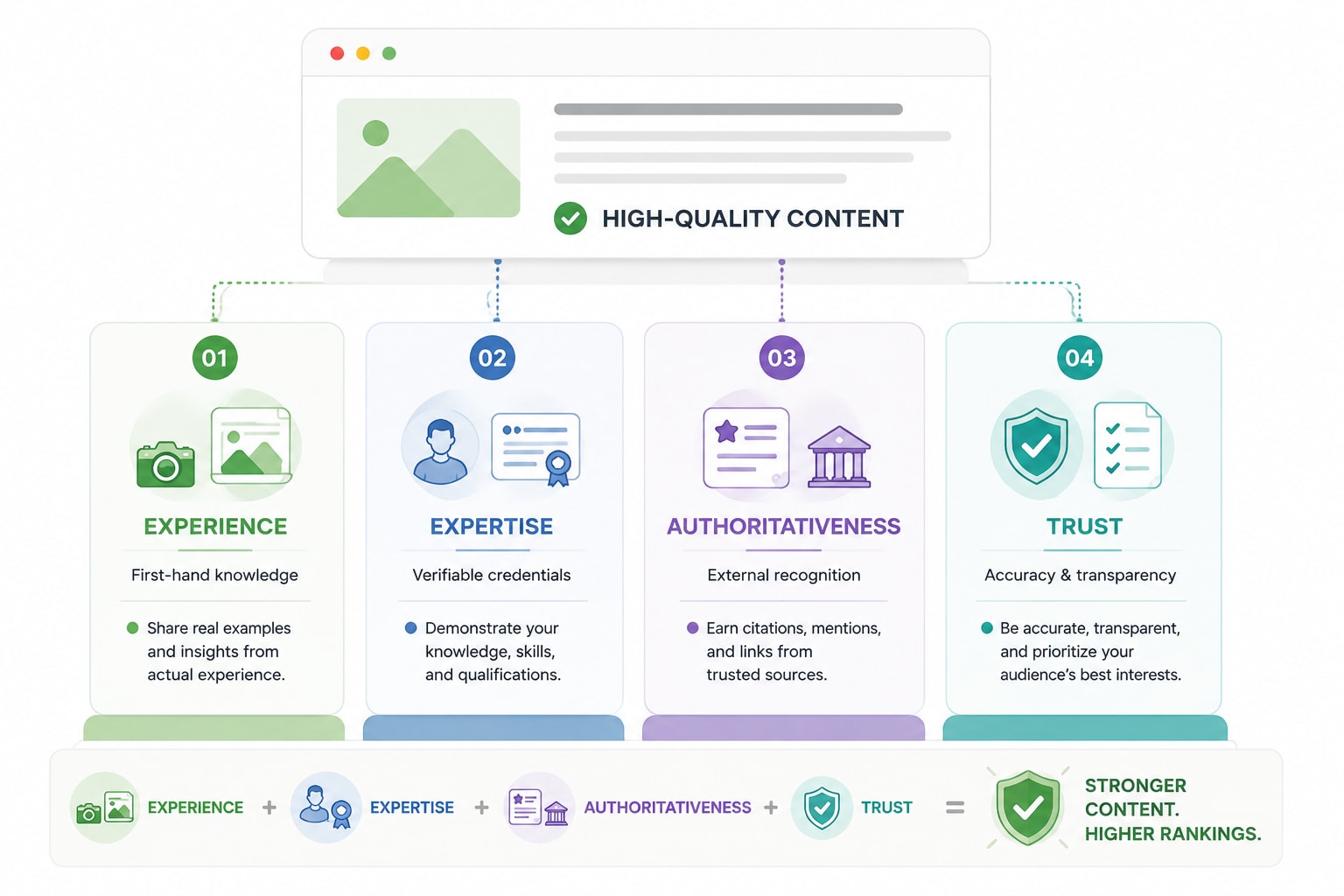
Understanding each pillar individually matters because each one requires a different type of signal, and each one has a different failure mode. Here's how they work.
Experience: First-Hand Knowledge of the Topic
Experience is the newest pillar and the one that most fundamentally separates genuine content from content that merely appears authoritative.
The question Google is asking is: did this person actually do the thing they're writing about? Not just research it, summarize it, or synthesize what others have said, but directly, personally engage with it.
The distinction is easier to see in examples. A review of a software tool written by someone who used it on a client project carries experience signals. A roundup of software tools assembled from other reviews does not. A travel guide written by someone who visited the destination contains experience signals. A travel guide compiled from other travel guides does not. A piece about managing chronic pain written from a patient's perspective has experience signals that a clinically accurate but third-person account lacks.
This is the pillar that is hardest to fake, and increasingly, it is the pillar that separates content that ranks from content that doesn't, particularly as AI-generated content floods the web with accurate-but-impersonal text.
In practice, experience signals look like dated personal accounts, original photography or documentation, case studies drawn from the author's own work, specific data the author collected, and details that are only accessible to someone with direct involvement.
Expertise: Verifiable Author Credentials
Expertise is where many content teams realize the bar has moved further than they anticipated.
Google evaluates not just what was written, but who wrote it. This is a substantive shift from an era when well-researched, well-written content was sufficient. Today, for a large and growing category of topics, the author's verifiable qualifications are part of the quality signal.
Expertise comes in two forms. Formal expertise includes degrees, certifications, professional licenses, and institutional affiliations. A physician writing about medication interactions, a CPA writing about tax strategy, a licensed attorney writing about contract law. These are clear formal expertise signals.
Informal expertise is equally legitimate and covers practitioners who have built deep, demonstrable knowledge through sustained professional experience without formal credentials in every area. A developer who has shipped twenty production systems is an expert. A marketing professional with ten years of documented campaign results is an expert. The key is that the expertise is demonstrable and visible through published work, professional history, peer recognition, or documented results.
The most common failure point here is the author bio. Most content teams either publish anonymously or with a generic name and no supporting context. An author bio is not a formality, it is a credibility signal. An effective one includes the author's relevant credentials or professional background, links to their external profiles (LinkedIn, institutional pages, or published work), and specific context for why they are qualified to write about this topic. That last piece is the one most teams skip.
Authoritativeness: External Recognition and Reputation
Authority is external validation. You cannot declare yourself authoritative because authority is established when other credible sources recognize and cite you.
At the author level, authority accumulates through bylines in respected publications, citations by other subject-matter experts, participation in industry panels or conferences, and consistent publication history within a specific domain.
At the domain level, authority is built through editorial links from high-quality, topically relevant sites, mentions in authoritative industry publications, knowledge panel presence, and the overall reputation of the site as a go-to source within its category.
The practical implication is that backlink quantity is not the metric that matters here. A single citation in a respected industry publication does more for authoritativeness than dozens of low-quality directory links. Quality raters are specifically trained to look at what the broader web says about a site or author, not just what the site says about itself.
Trustworthiness: The Most Important Pillar
Google positions Trust as the most important element in E-E-A-T. The other three pillars all feed into and support Trust. A page that demonstrates all three but has accuracy problems, undisclosed conflicts of interest, or no transparent authorship is still a low-trust page.
Trust operates at two levels.
Content-level trust means the information is accurate, current, properly sourced, and honest about uncertainty. It means citing sources rather than asserting facts without foundation, flagging when information was last verified, and avoiding exaggeration or misleading framing.
Site-level trust means the infrastructure around the content supports the content's credibility. This includes clear authorship on every page, a substantive About page with real team information, contact information, an editorial standards or corrections policy, and transparency about the organization publishing the content. Quality raters look at the site as a whole. A single well-sourced article sitting on a site with no About page, no authorship, and no contact information does not score as a high-trust page.
E-E-A-T and YMYL Content
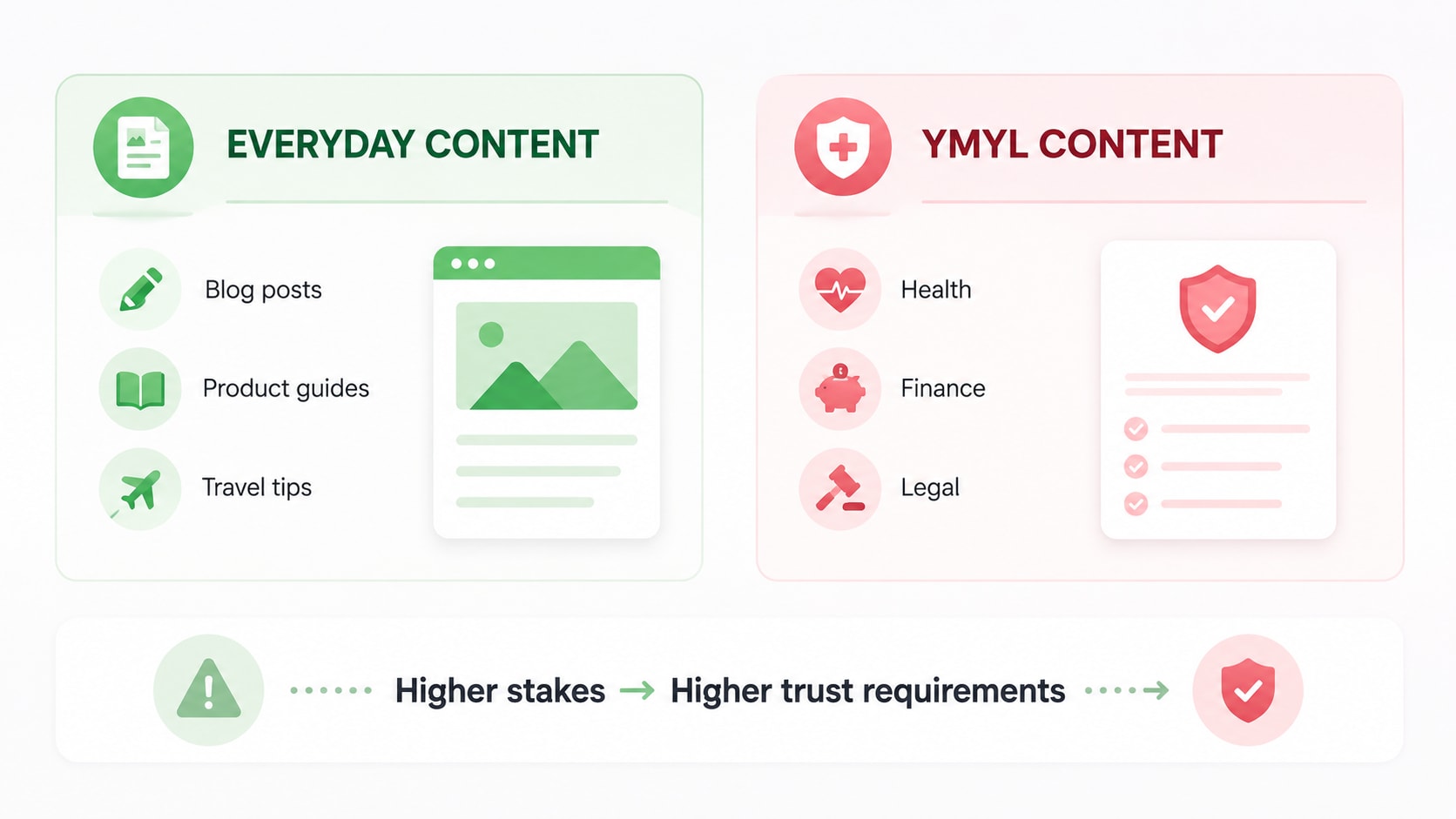
Not all content is evaluated under the same E-E-A-T threshold. Google applies significantly stricter standards to what it classifies as YMYL content: "Your Money or Your Life."
YMYL covers content categories where inaccuracy, bad advice, or low-quality information can cause real-world harm, such as health and medical information, personal finance and investment advice, legal guidance, safety instructions, and news and civic information. The classification exists because the cost of ranking a low-credibility page in these categories is not just a poor user experience, it is a person making a wrong decision about their medication, their financial security, or their legal standing.
For YMYL content, Google expects demonstrable credentials from authors, clear sourcing for every factual claim, explicit transparency about who is publishing the content and why, and a correction process when errors are identified. The informal expertise threshold that applies elsewhere is not sufficient here. One passionate amateur writing about heart medication interactions is not acceptable under Google's YMYL standard, regardless of how accurate the content happens to be.
For content managers, the YMYL classification has a practical implication that extends beyond strictly medical or legal content. A personal finance comparison article, a health and wellness guide, a legal rights explainer for employees. These sit in YMYL-adjacent territory where E-E-A-T standards are elevated. If any meaningful portion of your content touches these categories, treating E-E-A-T as optional is not a viable strategy.
Where Most Content Teams Fall Short on E-E-A-T
Most content teams are optimizing for the wrong thing. They invest in writing quality, content depth, and keyword coverage, all of which matter, while the bar Google is actually evaluating against has moved to verifiable expertise and demonstrated credibility.
The most common failure is anonymous publishing. Content teams regularly produce detailed, accurate, well-structured articles with no named author, or with a generic author name and no supporting context. From Google's perspective, and specifically from the perspective of a quality rater evaluating that page, anonymous content has no expertise signals. There is no one to verify. The article may be excellent, but it cannot score high on E-E-A-T when the author's credibility is invisible.
The second most common failure is the credentialing gap. A content manager might know their subject matter well, but unless that knowledge is externally documented, through published work, professional credentials, or industry recognition, Google has no signal to evaluate. Good writing from an undocumented author does not satisfy the Expertise pillar.
The third failure is treating E-E-A-T as a content strategy problem when it is fundamentally a talent and credibility problem. You cannot write your way to strong E-E-A-T signals. You need the right people creating the right content, with their credentials visible and verifiable.
Three Moves to Build Your Brand Credibility
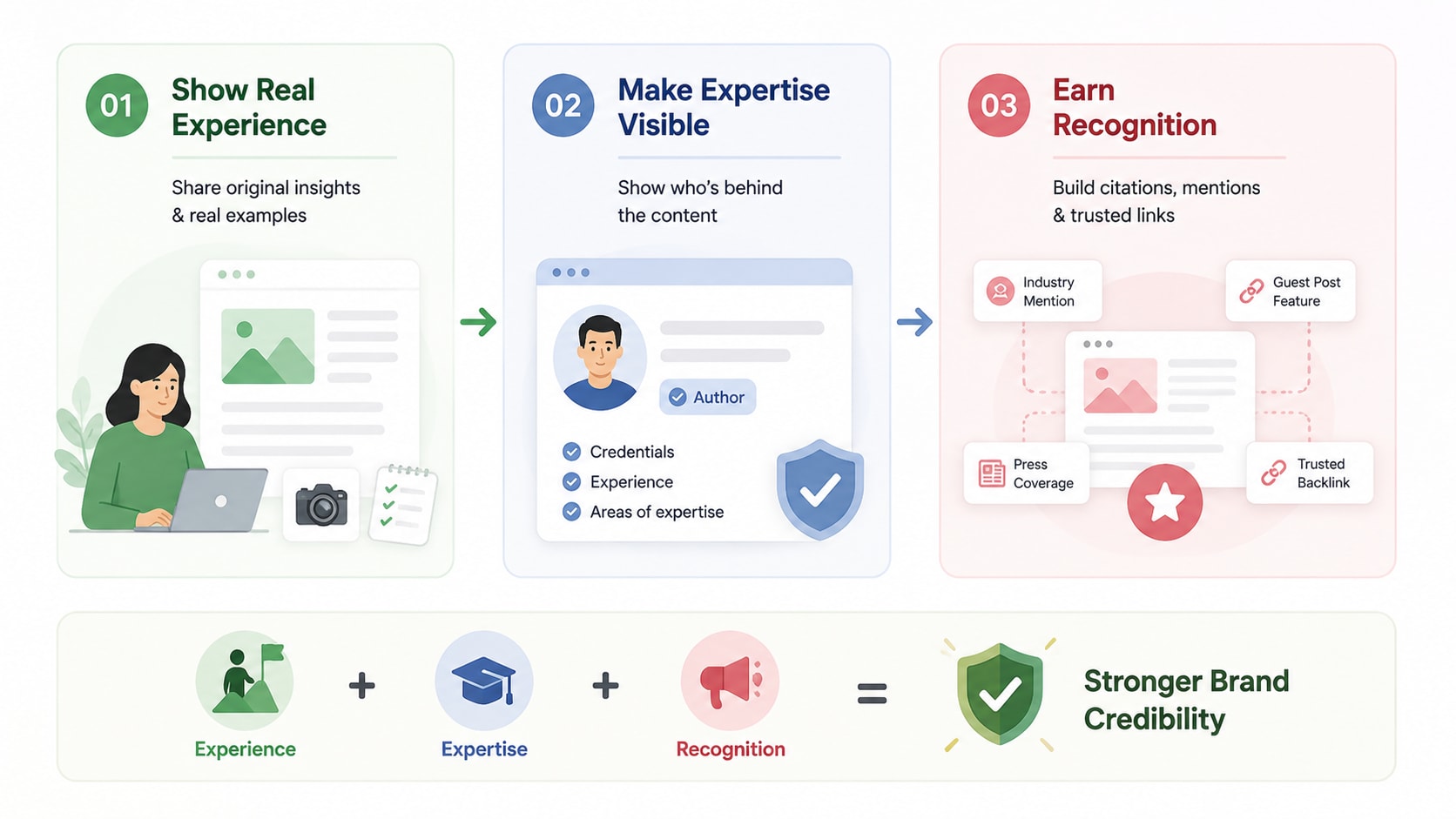
Everything in the playbook below works, but if you need the shortest practical path to recognizable, machine-readable brand credibility, it comes down to three things.
1. Build brand presence outside your website
Credibility starts where you don't control the narrative: Reddit threads, active social profiles, industry press, podcast appearances, PR. The goal is simple: when a search engine, a generative engine, or a human checks who you are, the brand is already known and the sentiment around it is positive. This has become measurably more important because discussion platforms are among the sources generative engines lean on most when forming answers. The market has noticed: demand for Reddit-related brand and sentiment services on Fiverr grew 42% between May 2025 and May 2026.
2. Build topical authority around the brand, with your website as the central asset
External buzz needs a home base. Establish a professional blog that covers your niche in depth, publish proprietary data that only your brand can produce, and invest in genuine deep-dive analyses rather than thin coverage. Original data is the single strongest asset here: articles featuring proprietary data drive 83% more traffic value and 51% more organic traffic than those without first-party insights, according to Siege Media. Proprietary numbers are also exactly what generative engines love to quote. A statistic no one else has is a citation only you can win.
3. Assign a professional persona to each niche you cover
Choose a real, credentialed professional for each core topic area and have them sign every related article. If your brand publishes about GEO, your SEO lead's name should be on every GEO piece, exactly the way this article carries its author's byline. One consistent, verifiable expert per niche beats a rotating cast of generic bylines.
Then make sure the infrastructure supports the persona:
- Author and Person schema. Mark up the author on every article with a Person element (name, jobTitle, knowsAbout, sameAs), referenced from the author property of your Article schema, plus a ProfilePage-marked-up bio page.
- Presence beyond your site. The persona should be active and findable on LinkedIn and relevant social platforms, with a profile that matches the credentials stated on your site. Raters and engines both cross-check.
- Recognition in the niche. Guest posts, conference talks, podcast interviews, and quotes in industry publications: external recognition is what upgrades a byline from a name into an authority.
How to Improve Each E-E-A-T Signal
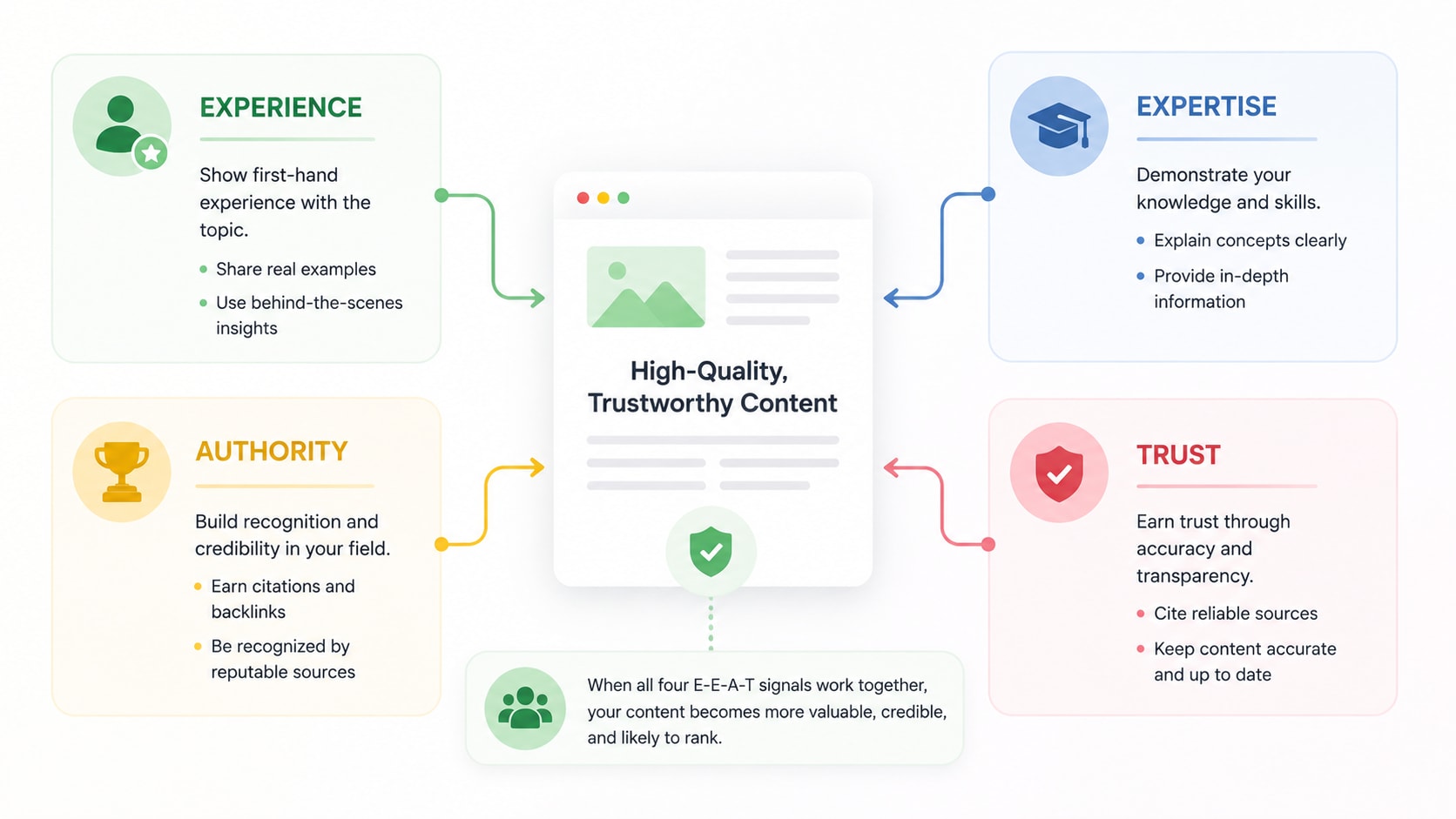
- Here is one concrete, actionable fix for each pillar. These are not comprehensive strategies, because they are the highest-leverage starting points for teams that need to move.
Experience: Show First-Hand Involvement
The fix: ensure every high-stakes piece of content contains documented evidence of direct engagement with the subject.
This means building in specific, verifiable details that only come from direct involvement, not from research. Where did the author first encounter this problem? What did they actually do? What result did they observe? What would they do differently?
In practice, this might look like an author note at the start of an article establishing their direct context, a case study section drawn from the author's own work, original data the author collected, or documented observations from their experience. What it does not look like is third-person synthesis of existing sources, however well-executed.
For content teams managing multiple authors, this means building experience documentation into the briefing process. Don't ask writers to research the topic, ask them what they've done with it, and build the content around that.
Expertise: Add Named, Credentialed Authors
The fix: replace anonymous or generic bylines with named, credentialed authors, and give every author a bio that actually earns its place.
A high-performing author bio includes the author's name, their relevant professional background, their specific credentials or qualifications for this topic, links to their external professional profiles, and for YMYL or technically complex content, either a credentials statement or an expert review attribution.
This is not cosmetic. Quality raters are explicitly instructed to look for author information and to evaluate whether the stated credentials are plausible and verifiable. A bio that says "Jane is a content writer who loves marketing" fails this test. A bio that says "Jane has ten years of B2B content strategy experience and has led SEO programs for enterprise SaaS companies" with a link to her LinkedIn profile passes it.
For technical or YMYL-adjacent content, consider adding a visible expert review layer. One named subject-matter expert who has reviewed the content for accuracy, with their credentials stated. Major publishers in health and finance use this model, and quality raters are familiar with it as a credibility signal.
Authoritativeness: Earn Editorial Citations
The fix: shift link-building efforts toward editorial mentions and citations in authoritative, topically relevant publications, not generic directory links or paid placements.
The distinction matters because quality raters evaluate the nature of inbound recognition, not just the volume. A citation in a respected industry publication, a quote in a trade journal, or a reference in another expert's research carries authoritativeness signals. A link from a content farm does not.
The highest-leverage strategies for building a citation profile: publish original research or original data that other publications want to reference, pursue guest contributions to established industry outlets, participate in expert panels or roundup interviews, and invest in building a knowledge panel presence through consistent, verified entity information across the web.
These take time. That is by design. Authoritativeness is meant to reflect a real track record, not an overnight tactic.
Trustworthiness: Fix Site-Level Trust Signals
The fix: conduct an audit of site-level trust signals and treat any gaps as high-priority issues, not cosmetic maintenance.
Run through this checklist:
- Every page has a named author with a verifiable bio
- The About page includes real information about the organization, its mission, and the team behind it
- Contact information is current and functional
- An editorial standards page or correction policy exists and is accessible
- Every factual claim in published content links to a primary source
- Dates are accurate and reflect when content was last reviewed, not just published
- Any affiliations, sponsored content, or conflicts of interest are disclosed
Quality raters look at the site as a whole when evaluating a page. A single excellent piece of content cannot compensate for a site that appears to have no accountable publisher behind it.
What E-E-A-T and Google's Core Updates Mean for Rankings
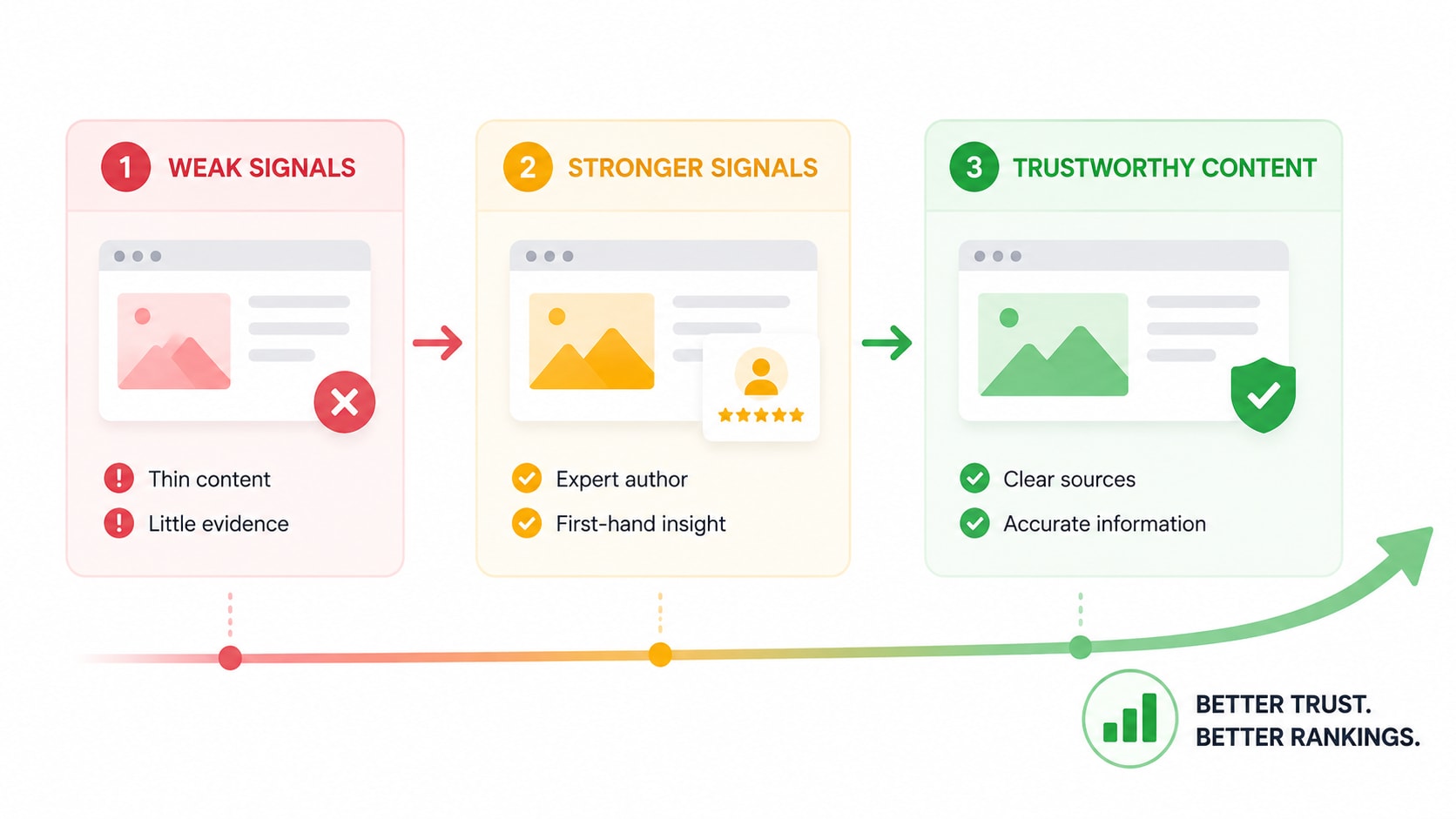
It's worth being precise about how E-E-A-T connects to rankings, because the common framing gets it slightly wrong.
E-E-A-T is not a ranking factor in the sense that meta descriptions or page speed are ranking factors. Google has not built an E-E-A-T score into its algorithm. What it has done is use the E-E-A-T standard as the framework that quality raters apply when evaluating pages, and those evaluations feed directly into how Google trains and refines its ranking systems.
The practical consequence shows up most clearly in Google's Core Updates and the Helpful Content Update. These updates are specifically designed to reward content that demonstrates genuine expertise, real-world value, and reliable sourcing, and to reduce the visibility of content that performs those qualities without actually having them. Sites with strong E-E-A-T signals tend to hold or gain ground after these updates. Sites with weak signals, particularly those relying on content volume or technical optimization without credibility, tend to lose it.
This is why E-E-A-T strategies produce more durable results than purely technical SEO approaches. Technical factors can be replicated quickly. Genuine credibility, the kind that shows up in verified author credentials, editorial citations, and a documented track record, cannot. And as covered above, that same durable credibility is what earns citations in AI-generated answers, the visibility channel that is growing while traditional clicks shrink.
The bottom line is that E-E-A-T is not a campaign you run once. It is a standard your content operation either meets or doesn't. Teams that treat it as a sustained operating baseline perform better across Core Updates, and across generative engines, than teams that treat it as a checklist item.
How to Build E-E-A-T Without a Full In-House Team
Here is the problem most content managers face when they reach this point in the playbook: executing on E-E-A-T signals requires human credibility, and human credibility is not something you can build on demand.
The industry has already voted with its budgets: only 14% of marketers now handle all content production in-house, down from 29% in 2023, according to Siege Media. Google doesn't just reward well-written content; it rewards content authored by someone with verifiable expertise in the field. A skilled writer without credentials won't move the needle on the signals that matter most. The talent bar has shifted, and it has shifted in a direction that makes in-house solutions harder, not easier, to scale.
The gap isn't a writing quality problem. It's a credentials problem. And credentials, by definition, take years to build.
For companies that need to close this gap without hiring full-time experts for every subject area, the practical solution is bringing in specialists who do this work every day. Building E-E-A-T correctly is a defined body of work: setting up author and Person schema, structuring author pages and bios, developing content with credentialed experts, earning editorial citations, and cleaning up site-level trust signals. SEO and GEO freelancers on Fiverr take on exactly this kind of work, helping brands build their E-E-A-T foundations properly, so that credibility translates into better rankings and more visibility in both traditional search results and AI-generated answers.
If you want to start with the surface that's growing fastest, find a GEO freelancer on Fiverr to make sure your credibility signals (author markup, structured data, citable facts) are built the way generative engines can read and cite.
Improve Your AI Visibility Today
Get help with your GEO strategy from top-rated freelancers.

FAQs
E-E-A-T stands for Experience, Expertise, Authoritativeness, and Trustworthiness, the four-pillar framework Google uses to evaluate the quality of content and the credibility of the people and organizations that publish it. The framework comes from Google's Search Quality Rater Guidelines, which human quality raters use when assessing the quality of search results. Those assessments inform how Google trains and refines its ranking systems over time. Trust is positioned as the most critical pillar; the other three feed into it.
Related Guides




About the author
Gili Baruch-KlystAI growth specialist
A growth specialist on Fiverr’s Growth team, combining deep SEO expertise with advanced AI capabilities to drive scalable, data-driven performance.
