 August 3, 2026
 8 minute reading
If you have started hearing "GEO" in marketing conversations and are not sure whether it replaces SEO or adds to it, you are not alone. Demand for GEO services on Fiverr grew more than 5x in a single year, comparing May 2026 to May 2025, according to Fiverr marketplace data. The businesses driving that number are not waiting for the discipline to mature. They are already hiring.
This article gives you the clearest answer available on what GEO is, how it differs from SEO and AEO, why it is becoming harder to ignore, and what you can do about it today.
What Is Generative Engine Optimization (GEO)?
Generative engine optimization is the practice of structuring and formatting web content so AI-powered search tools are more likely to cite your pages in their generated answers.
Tools like ChatGPT, Perplexity, Google AI Overviews, and Bing Copilot do not return a ranked list of links the way traditional search engines do. They retrieve the top-ranking pages for a query, process the text, and synthesize a single written response with inline citations. The page that gets cited is the one that wins visibility, whether or not the user ever clicks a link.
That changes what showing up means. In traditional search, visibility is a blue link at position one. In generative search, visibility is a sentence inside the AI's answer. GEO is how you earn that sentence.
A 2024 research paper from Princeton, Georgia Tech, IIT Delhi, and the Allen Institute for AI found that simple content edits, specifically adding statistics, expert quotes, and explicit citations, raised citation share by up to 40% across diverse topic categories. The tactics that move the needle are learnable and repeatable.
GEO vs. SEO: What's the Same, What's Different
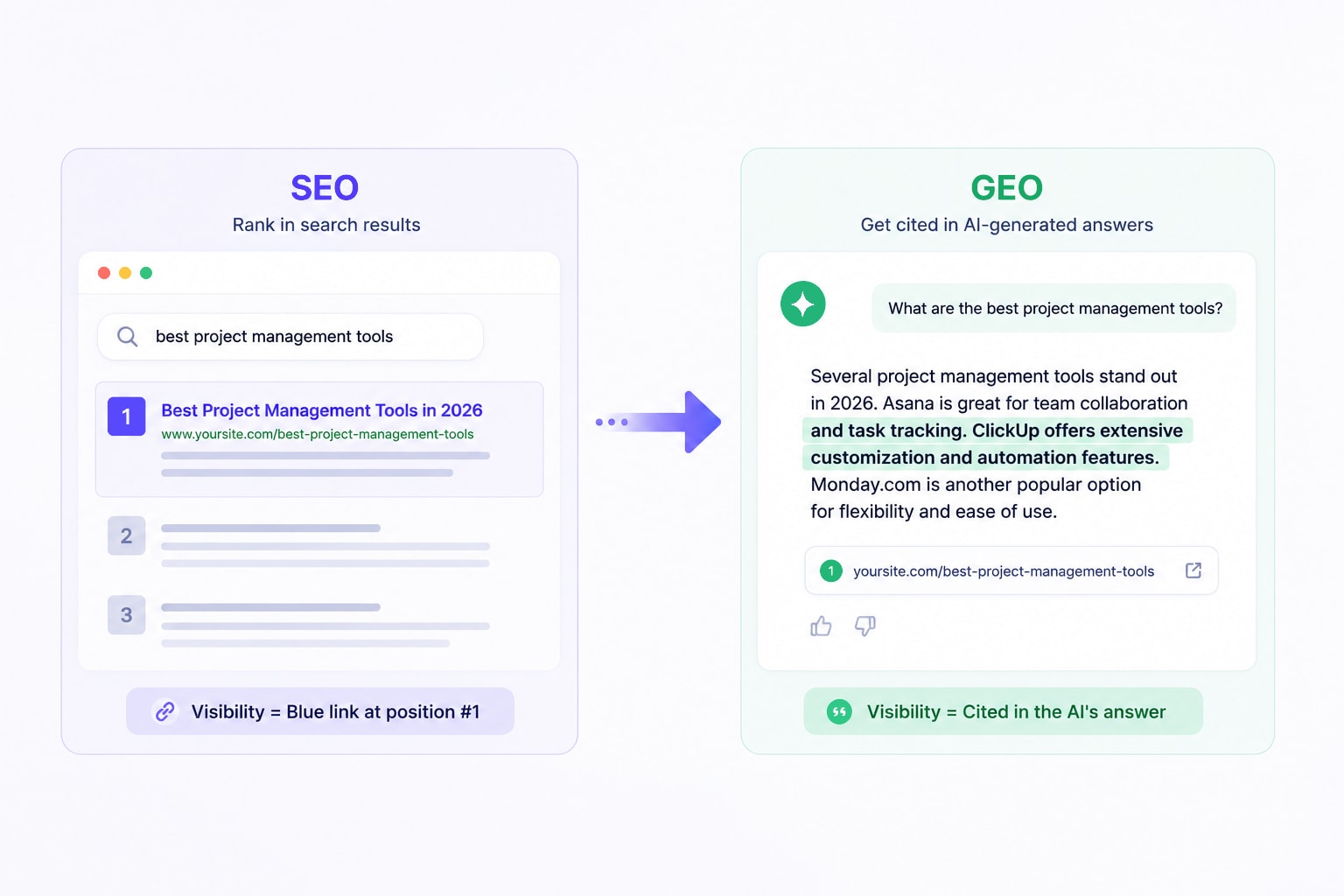
If you already work in SEO, you do not need to throw out everything you know. The two disciplines share a lot of common ground.
Both aim to win a user's attention the moment they ask a question, whether in a search results page or a ChatGPT window. Both measure success with the same downstream metrics of traffic, leads, and revenue. And both depend on content that directly answers what the user is looking for.
The difference is in what each one optimizes for. But before we get into that, one thing is worth stating plainly: GEO is a layer built on top of SEO, not a replacement for it.
SEO
GEO
Goal
Rank a link in search results
Get cited and mentioned in an AI-generated answer
Optimization target
Keywords, backlinks, page authority
Citability, structured facts, source credibility
Success metric
Click-through rate, organic sessions
AI citation frequency, brand mentions in generated responses
Key tactic
Content relevance, technical site health
Statistics addition, quotation addition, FAQ schema
Key risk
Thin content, slow load times
Keyword stuffing, which depresses LLM visibility by roughly 10%
SEO still feeds GEO, and that relationship matters. Generative engines start their process by retrieving the top search results for a query. If your pages are not ranking in traditional search, they will not be in the candidate pool for AI citations either. SEO gets you in the room. GEO makes sure the engine quotes you once you are there.
The same Princeton and Georgia Tech study found that adding authoritative citations boosted AI visibility by 115% for sites not already ranking at the top. That is a significant competitive opportunity for any business that is not at position one.
GEO vs. AEO: Are They the Same Thing?
They are closely related, but not identical.
Answer engine optimization, or AEO, predates GEO. It refers to the practice of optimizing content to appear in traditional answer boxes, featured snippets, and voice search results inside standard search engine results pages. Structured data, FAQ schema, and clean question-and-answer formatting are all AEO fundamentals.
GEO extends those same principles into generative AI outputs. The goal in both cases is content that is quote-ready, clearly structured, and easy for an algorithm to extract and surface. The difference is in where that content needs to perform. AEO targets position zero in a Google results page. GEO targets a cited sentence inside a synthesized AI response.
If you have already invested in AEO, you have a stronger foundation for GEO than you might think. The schema work, the Q&A formatting, the focus on direct answers to specific questions all transfer. GEO mostly adds one more layer of precision around data points, citations, and source credibility.
Why GEO Matters Right Now?
The numbers make a compelling case on their own.
SparkToro's 2026 zero-click study found that 68% of US Google searches now end without a click to any website, up from around 60% in 2024, the fastest acceleration in a decade. The same study found that Google AI Overviews now appear on more than 20% of all searches.
When an AI Overview does appear, the damage is measurable. Ahrefs' updated study of 300,000 keywords found that the presence of an AI Overview correlates with a 58% lower click-through rate for the top-ranking page, nearly double the 34.5% drop the same team measured in early 2025. Pages in position two lost about half their clicks, and even position ten saw drops of nearly 20%.
The practical implication is that visibility inside AI-generated answers is becoming the new scarcity. The marketers who build for it now are creating a competitive advantage that most of their competitors have not started thinking about.
Where Will the Traffic Go?
While the expectation is that GEO will directly increase traffic and conversions from LLMs, that is unlikely to be the primary outcome, at least for now. Here is what you should realistically expect:
- Traditional search traffic is shrinking faster than LLM referral traffic is growing. As more search questions are answered directly in AI experiences, fewer users click through to websites. The zero-click numbers above are the clearest evidence of this trend.
- LLMs have little incentive to send users away. Chat interfaces are designed to answer questions within the conversation, not to maximize outbound clicks. Even when sources are cited, clicking them is not the default user behavior.
- The biggest impact is on brand awareness and discovery. Getting mentioned more often across AI platforms rarely drives clicks directly, but it does drive awareness. That awareness tends to convert later, through branded searches, direct visits, and organic traffic. Users often discover a brand in ChatGPT or Gemini, then later search for it on Google, click an ad, or go straight to the website.
- The traffic that does arrive is worth more. Adobe found that visitors reaching US retailers from AI sources grew nearly 400% year over year in early 2026, and once they land, they convert about 42% better than non-AI traffic, as reported by SparkToro. AI-referred visitors arrive further down the funnel, already informed by the answer that sent them.
This gap between discovery and action is where GEO delivers most of its business value today.
How to Optimize Content for Generative Engines
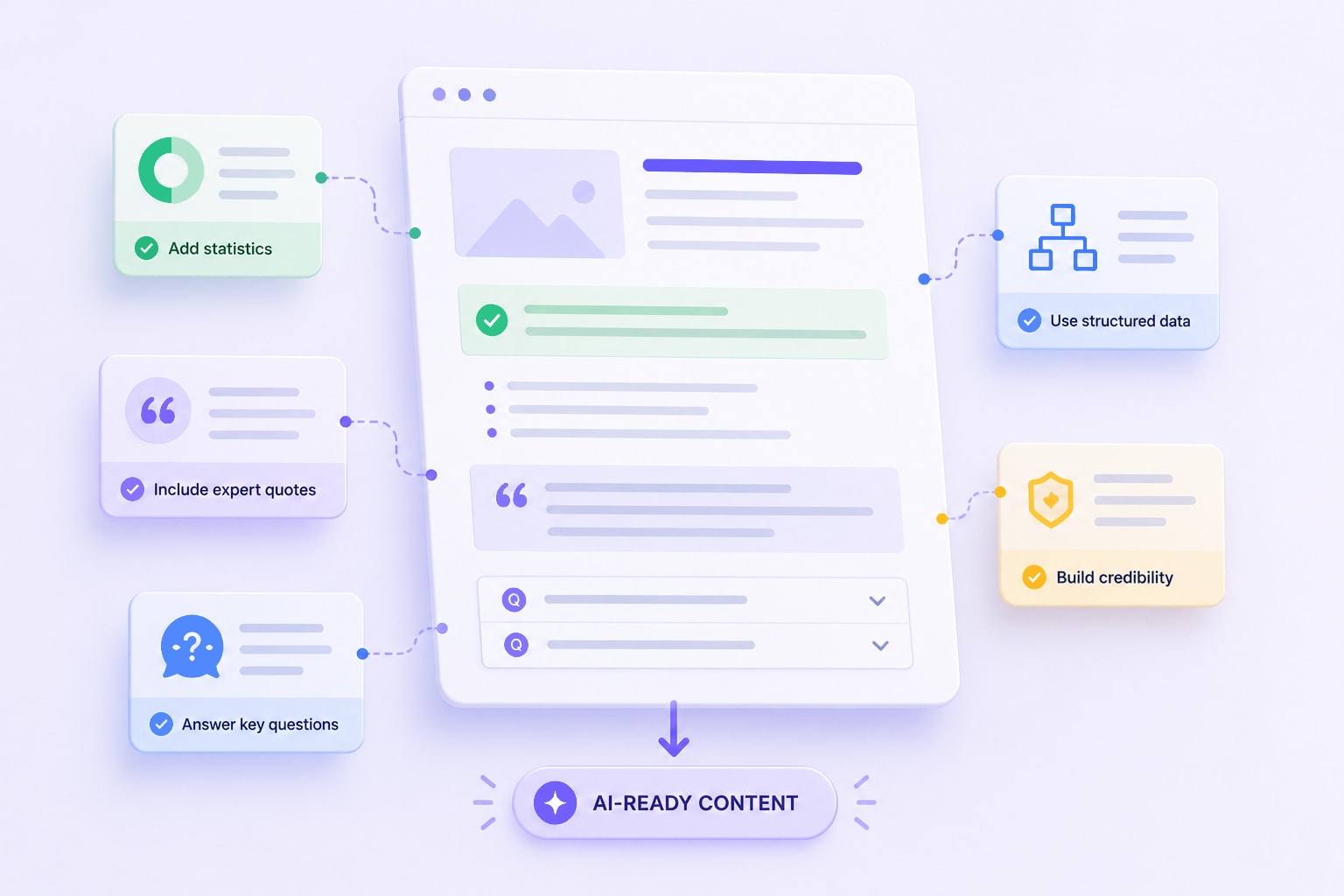
1. Open every page with a citable stat or expert quote
Put a numeric data point or an authoritative quote within the first 250 to 300 words of any page you want cited. The Princeton and Georgia Tech study found that Statistics Addition and Quotation Addition raised LLM visibility by 22 to 37% in live Perplexity tests. Replacing a vague qualifier like "many businesses" with a specific percentage and a source citation was the single largest visibility lift measured across nine different content domains.
2. Format for machine parsing
Generative engines process content in chunks. Dense paragraphs without clear structure are harder to parse and quote accurately. Use H2 and H3 headings, short paragraphs, and bullet lists to make each section self-contained and extractable. The GEO study calls this Fluency Optimization, and it adds between 15 and 30% LLM visibility on its own. Combining it with Statistics Addition outperforms either tactic alone by another 5 to 6%.
3. Serve your content with server-side rendering (SSR)
This is the technical requirement most teams underestimate. Vercel's large-scale analysis of AI crawler behavior found that none of the major AI crawlers execute JavaScript. GPTBot, ClaudeBot, and PerplexityBot fetch the raw HTML and read only what is already in it. They sometimes download JavaScript files, but they never run them. Content that loads client-side simply does not exist in their view of your page.
For years, the standard reassurance was that JavaScript-heavy sites were fine because Googlebot renders JavaScript. That is no longer an excuse. A page can rank at position one on Google and still be a blank shell to ChatGPT, Claude, and Perplexity at the same time. Gemini is the only major exception, because it inherits Google's rendering infrastructure. If your product descriptions, comparison tables, or FAQs load via client-side JavaScript, make sure that content is server-side rendered or present in the initial HTML response. SSR was always good practice for SEO. For GEO, it is critical.
4. Apply FAQ and structured data schema
An FAQPage schema block turns each question-and-answer pair into a self-contained fact that a generative engine can pull verbatim. Write numeric claims with units rather than vague references to growth. A phrase like "AI Overviews appear on more than 20% of US searches and cut position-one click-through rates by 58%" is a high-signal format that fits cleanly into a structured AI response. The GEO study found that citation-style formatting alone can increase visibility inside Perplexity's answer pane by up to 132%.
5. Build E-E-A-T signals into every page
One sourced expert quote or a government statistic will outperform a paragraph of adjectives in the eyes of a generative engine. LLMs favor what researchers call verifiable atoms, meaning discrete, attributable facts that can be dropped into a synthesized response without modification.
Beyond the content itself, make your expertise machine-readable. Concrete implementations to prioritize:
- Person schema for authors. Mark up every author with a Person element that includes name, jobTitle, knowsAbout, and sameAs links to their LinkedIn profile or other verifiable presences. This lets engines connect the content to a real, credentialed human.
- Author attribution in Article schema. Reference that Person element in the author property of your Article or BlogPosting markup, so the byline is a structured entity rather than a plain text string.
- ProfilePage schema for author bio pages. A dedicated, marked-up author page consolidates credentials, publication history, and social profiles into one entity that both Google and generative engines can resolve.
- Visible credentials and outbound sourcing. Clear author bylines with titles, reviewedBy markup for expert-reviewed content, and outbound links to primary research all raise the trust signals a model weighs when deciding which sources to cite. Show your work.
6. Earn brand mentions and positive sentiment, not just backlinks
For years, off-site SEO meant one thing: acquiring external links. That strategy was so dominant it spawned the entire PBN (private blog network) industry, built on manufacturing links at scale. Generative engines shift the weight. More than the external link itself, what matters is the mention: whether your brand is named at all in the sources the engine reads, in what context, and with what sentiment. That sentiment carries directly into the answers users see, because the model characterizes your brand the way the sources it retrieves characterize it.
Reddit is a significant part of this picture. Discussion platforms, and Reddit in particular, are consistently among the most heavily cited sources in AI-generated answers, which makes authentic community presence and sentiment management a visibility lever, not a side project. The market has noticed: demand for Reddit-related brand and sentiment services on Fiverr grew 42% between May 2025 and May 2026.
7. Publish an llms.txt file
llms.txt is a proposed standard, published at llmstxt.org, that places a curated Markdown map of your most important pages at yourdomain.com/llms.txt, alongside robots.txt and sitemap.xml. The goal is to give LLM crawlers a clean, prioritized view of your content instead of leaving them to parse every HTML page. Fiverr publishes its own at fiverr.com/llms.txt.
Be clear-eyed about what it does and does not do: no major AI provider has publicly committed to using it, and there is currently no evidence it directly improves citations (more on this in the FAQ below). But it costs almost nothing to implement, it makes your site more legible to anything that does read it, and it future-proofs you if the spec catches on.
8. Keep the rest of your SEO basics in order
Everything above sits on top of fundamentals that have not gone anywhere. Because generative engines retrieve from the same index that traditional search builds, weak SEO basics quietly remove you from the candidate pool before any GEO tactic gets a chance to work. The checklist:
- Lead with the main action or answer. Open every page with the primary answer, or the main action you want the user to take, before the background and context. Users get what they came for immediately, and generative engines weigh content that appears early on the page more heavily than content buried below.
- Optimize by keyword clusters, not isolated keywords. Group related queries into topic clusters and cover each cluster with a dedicated, interlinked set of pages. This builds the topic authority that both Google rankings and AI citations reward, and it prevents your own pages from cannibalizing each other.
- Site architecture and internal links. A clear hierarchy with descriptive internal anchor text helps crawlers understand which pages matter most, and passes authority to the pages you most want cited.
- Images. Compress files, serve modern formats like WebP, and write descriptive alt text. Alt text is machine-readable context that both image search and AI systems can use.
- Page speed. Fast server responses matter twice: they are a ranking factor for Google, and slow pages get crawled less frequently by search and AI crawlers alike.
- Sitemaps and robots.txt. Keep your XML sitemap current so new and updated content gets discovered quickly. And review your robots.txt and CDN settings with fresh eyes: some firewalls and CDN defaults block GPTBot, ClaudeBot, and PerplexityBot without the site owner ever deciding to. Blocking AI crawlers means opting out of AI visibility entirely.
Find GEO Talent on Fiverr
GEO is a multi-disciplinary skill set. Doing it well requires research to surface credible data, writing to structure it clearly, technical SEO to keep pages in the candidate pool, and schema implementation to make content machine-readable. Most in-house marketing teams do not have all of these skills sitting in the same place.
One thing to look for when hiring: a good GEO service will cover both SEO fundamentals and LLM visibility, because the two are inseparable. Fiverr connects you with top-rated freelancers with transparent reviews, ratings, and project-based pricing. From content restructuring and schema implementation to citation building and brand-mention campaigns, find a GEO freelancer on Fiverr and start turning visibility into results.
Improve Your AI Visibility Today
Get help with your GEO strategy from top-rated freelancers.

FAQs
GEO stands for generative engine optimization. It is the practice of structuring and formatting web content so AI-powered search tools, including ChatGPT, Perplexity, and Google AI Overviews, are more likely to cite your pages in their generated answers. Unlike traditional SEO, which targets a ranked link, GEO targets a quoted sentence inside an AI-generated response.
Related Guides






About the author
Gili Baruch-KlystAI growth specialist
A growth specialist on Fiverr’s Growth team, combining deep SEO expertise with advanced AI capabilities to drive scalable, data-driven performance.
